Franck Marchis is fueled by grit and stardust
Senior Content Editor at Mercury
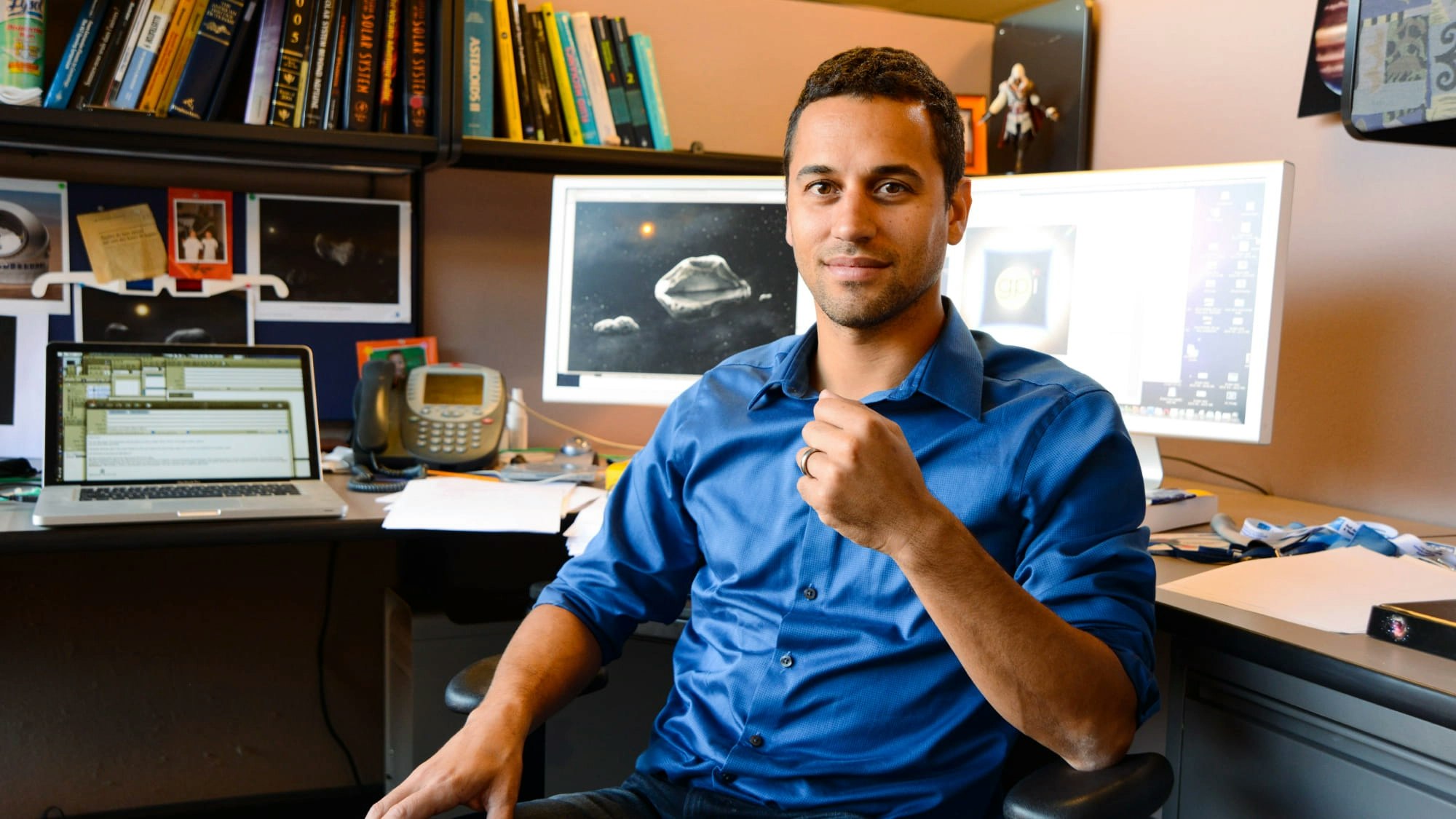
Franck Marchis is co-founder and CEO of Skymapper, an early-stage startup seeking to democratize space exploration through a decentralized network of real-time data. He’s also co-founder of Unistellar — the company behind the world’s largest network of “smart” telescopes — and serves as Director of Citizen Science at SETI (Search for Extraterrestrial Intelligence) Institute. His previous research includes developing instrumentation to discover new exoplanets.
A version of this story was first published in a print resource kit for Mercury Spheres in May 2025. Nearly a year later, Skymapper launched publicly in April 2026, leading us to revisit our conversation.
Andrew Shen: Skymapper is your second startup — and with it you’re embarking on a lofty mission: “to democratize space exploration in an unprecedented way.” What’s driving this ambition?
Franck Marchis: I believe that the next new space for humanity will be space. I know it’s a weird sentence to say — but we are going to expand no matter what. We’ve been on this planet for millions of years and it's time for us to see the universe.
I’ve spent many years looking for new stars and planets — and we found one in 2015, one hundred light years away from us. After that, I found myself wanting to do something a bit more connected to people on this planet.
We’re starting to explore the solar system through low-cost satellites and telescopes — which are important extensions of humanity. It’s basically a way for us to connect to and see the cosmos. We want to bring more people into this exploration. My first company, Unistellar, was all about revealing the beauty of the cosmos to people by equipping them with telescopes that they can understand and use.
Now that we’re finding ways for more people to see more, Skymapper is about giving them a task — something they can do. They can observe satellites and supernovae, they can observe any interesting scientific events happening in the sky, and now they’ll have a way to participate and share what they’re seeing.
We want to connect the young generation to space. And my hope is that one of these people will be the next Einstein of astronomy, the next big entrepreneur, who can make a major contribution to this field.
What is it about the challenge that Skymapper is addressing that made you think, “This needs a dedicated, separate company”?
We wanted to have a company which is free of an already established brand. When you want to start a new idea, you need to start from scratch. One very practical reason is we want Skymapper to include all users and all devices capable of observing the sky, not just telescopes from Unistellar. We want an open, unbiased ecosystem.
I’ve spent many years looking for new stars and planets — and we found one in 2015, one hundred light years away from us. After that, I found myself wanting to do something a bit more connected to people on this planet.
The second reason is because when you create a company, you create it with people and build a very specific team who is passionate and capable of addressing the challenge at hand. For Skymapper, there’s a heavy incorporation of blockchain and AI. Not everyone — like myself — has a background in fields like these, that may become important parts of your new company or product.
I created Skymapper with my friend, Stefaan Vervaet, who I’ve known for twenty years. We grew up together as “San Francisco immigrants,” as we called ourselves. [Marchis is originally from France.] We took different paths but kept in touch, and now his experience across data storage, blockchain, and the world of Web3, merged with my expertise, formed a no-brainer partnership for what we’re building with Skymapper. That’s not something we’d be able to do within the confines of another organization.
Congratulations on your recent platform launch — what’s been the biggest shift in your product development or positioning since initially forming the company?
We started by building the infrastructure to connect telescopes on the ground, with the idea that the natural next step would be to expand into space-based assets, like cameras and telescopes, for space situational awareness.
But along the way, something unexpected happened. One of our instruments, SkySphere, an all-sky camera, showed strong potential for real-time detection of drones. Given recent geopolitical events and the growing need for airspace awareness, this quickly became a priority.
So about six months ago, we made the decision to accelerate this part of the project. What began as a tool for astronomy is now also becoming a real-time sensing network for drone detection, with early customers soon in Europe and the U.S.
It’s a good example of how building flexible infrastructure allows you to discover use cases you didn’t initially anticipate — and move fast when they matter.
What are the key signals you’re looking for in the first few months of the platform being live?
The first signal is adoption — seeing thousands of people join the platform and start collecting their own observations. That’s the foundation of everything we’re building.
The second is network growth. We want to scale from where we are today to about 300 telescopes in the next two months, and reach 1,000 within the year. That density is what unlocks real-time, global coverage.
The beauty of what we’re building is that it’s not dependent on one person. And I think that’s really motivating.
And beyond the numbers, we’re looking at engagement: Are people not just joining, but contributing meaningful data, coming back, and becoming part of a network that actually observes the sky continuously?
If we see strong participation combined with rapid expansion, then we know we’re on the right path toward building a truly global, real-time sensing network.
Many founders talk about their “aha moment” — but let’s talk about the opposite: What was the most compelling reason NOT to start the new company?
Well, I’m 53 years old. Many people at my age, especially in Europe, are thinking about retirement. Or they generally want to have a cool, relaxing job, and do the same thing for the next ten years and take advantage of the fact that they’re in good health and maybe the kids are out of the house. So it’s hard for that mindset to not at least cross your mind.
But when you do hit 50, or whatever “older” age, there’s also this freedom that suddenly comes back to you. We have one life. What’s cool about having your own idea or company, is that if it’s a good one, your idea will stay around — even well beyond your life. The beauty of what we’re building is that it’s not dependent on one person. And I think that’s really motivating. The notion of leaving a legacy in the field of astronomy made me more overcome any doubts.
If we imagine a spectrum where one end is “building what the market clearly wants right now” and the other is “creating something the world doesn't yet know it needs” — where does Skymapper fall?
Definitely that the world doesn’t know they need it yet. At first, people are like, “Yeah ok, platform to connect telescopes, so what,” but when I explain the purpose and talk about the evolution of humanity, I can see people’s eyes opening up. Avoiding, for instance, the Kessler effect that would be a catastrophic event that would close us from space. But yes, talking about a future need is a hard thing to do. You have to paint the vision.
You mentioned blockchain and AI as core to Skymapper — how have those technologies actually shaped the product so far, versus how you imagined they would?
Blockchain initially drew me in through the crypto world, but what became truly important for us is something much more fundamental: the ability to create an immutable, traceable record of observations.
In our case, that’s critical. We’re building a global sensing network, and the value of the data depends on trust — knowing where it comes from, when it was collected, and that it hasn’t been altered. Blockchain gives us that layer of verification. It also aligns with a growing need for data sovereignty: Different countries or partners can either share data within a common framework or keep their repositories clearly separated and controlled.
... it’s by making mistakes that you truly explore the unknown and push the limit of what we can do.
AI, on the other hand, has evolved much faster than I initially expected. Over the past year, it has significantly accelerated our transition from prototype to product. It helps us automate data processing, improve detection capabilities, and ultimately make the network smarter.
It also had a very concrete impact on the company itself: The speed of progress in AI raised the bar for execution, which pushed us to accelerate our fundraising. That’s one of the reasons we’re doing a bridge round now, ahead of a larger seed round — because the opportunity is moving fast, and we want to move with it.
What’s a skill or perspective from your scientific research days that’s proving unexpectedly valuable in building a product company?
In the field of astronomy, there’s so much unknown. It can be humbling. And I think that’s trained researchers to speak openly about mistakes — to share what they learned and be able to bounce back quickly. So that’s the way I treat employees of my companies. I try to say, “We are not here to do everything perfectly. You’re here to do something that is difficult, and nobody else has done. If you fail at something, you can get back on your feet and try again.”
And I think that’s a very important perspective in entrepreneurship: to give freedom to people to make mistakes, because it’s by making mistakes that you truly explore the unknown and push the limit of what we can do.
What’s your favorite part about being a founder?
It’s a mix of creativity and ambition, and everything’s going fast. It’s like surfing. You have this momentum, you take it and lean into it, and it’s a good feeling. And there’s plenty of falling, but getting back up and adjusting your approach is fun. You come back home and you’re thinking about work — but in a positive way.
I do sometimes wake up in the middle of the night because there’s something I forgot about that’s very important. I like that. It reminds me of being a student at university again: You learn new things and you’re super excited about it and you talk to your friends about it. Entrepreneurship is similar. You have this moment in time to be curious and creative.
Let’s end on a space question for us laypeople. Do you think that extraterrestrial life exists — or that we’ll know for sure in our lifetimes?
In our galaxy, there are 400 billion stars. There are at least two planets around each star — so 800 billion potential planets. By many calculations, at least 300 million of those planets could have liquid water on the surface — which is the strongest indicator of life. So the odds are very high.
Now, intelligent life is another topic. At 4.5 billion years old, Earth is young. The galaxy is 13 billion years old. We actually missed the golden age of civilization. For that reason alone, I believe that there’s intelligent life elsewhere — but I don’t think we are yet advanced enough to see them.
About the author
Andrew is an editor and content marketer at Mercury, bringing his storytelling perspective from tech brands like Dropbox and PagerDuty and long-ago banking experience at Morgan Stanley. He’s based in San Francisco out by Ocean Beach.
Share article
Related reads
Daylight Computer founder Anjan Katta believes our devices can actually nourish us

The world is an array of edits