How I prep for interviews

Some ideas change the world. The exploration of these ideas demands work — reading the research, talking to the experts, and refusing to stay at the surface. Dwarkesh Patel’s practice begins there.
Patel is the host of Dwarkesh Podcast. Best known for his deeply researched, long-form conversations with leaders like Mark Zuckerberg, Satya Nadella, Demis Hassabis, and Ilya Sutskever, he has built a reputation for rigorous preparation and intellectually serious inquiry. Here, he examines his research process in more detail.
I spend about a week preparing for each interview on the podcast. I want to talk through what the prep process looks like, in part for anyone who wants to dig deep into similar topics, and in part for myself: I want to improve at my craft, and that requires introspection into what’s working and what could be better.
I always start by trying to get the lay of the land for whatever domain I’m focused on. What should I read? Who should I talk to? What’s most important to include? This can be a pretty frustrating part of the process. I’m dropped into a topic I know nothing about (space GPUs, the economics of LLM companies, you name it) and before I can actually start learning about it, I have to figure out how to learn about it and then assemble a curriculum.
Different types of interviews have different processes here. There’s one type, typically with a historian or a scientist, where the prep process is time-consuming but figuring out what to do is actually pretty straightforward. You look at the guest’s CV, you read their books, you read their papers, and you just jot questions down as you go.
But there’s another kind of interview where the topic is exciting precisely because there’s no 101 textbook — and that means that even assembling the curriculum for it is an exercise in discovery. A lot of conversations about AI are like this. For example, what do you read to prep for Ilya Sutskever? Maybe you could figure it out if you knew what Safe Superintelligence (SSI), the AI lab he co-founded, was working on. But if you did, the interview wouldn’t be so interesting in the first place. Or how do you get ready to discuss orbital data centers with Elon Musk? In 2050, maybe there will be a textbook about space GPUs, but for now, you just have to start making spreadsheet models and reading random papers about radiators and sun-synchronous orbits.
... before I can actually start learning about it, I have to figure out how to learn about it and then assemble a curriculum.
Once I’ve put together some sort of curriculum, I have to dive in and start reading. But even this isn't straightforward. It’s so easy to read through a full week of material only to realize you don’t understand even a very basic detail undergirding the whole subject.
For example, partway through preparing to interview Richard Sutton, the godfather of reinforcement learning, I realized I didn’t actually understand how deep learning works with RL. In deep learning, backprop can update individual weights because it “knows” how each one impacts the loss function. But in RL, the reward comes from the environment, which is an entirely separate system — it’s not obvious how any given parameter impacts the reward signal. I’d been reading for days before I noticed this gap in my understanding.
Even if I understand something properly, actually retaining that knowledge is a different story. Honestly, when I look back on some of my previous interviews, and I think about how much I read and how much I once knew about a topic versus how little I know now, it’s kind of tragic.
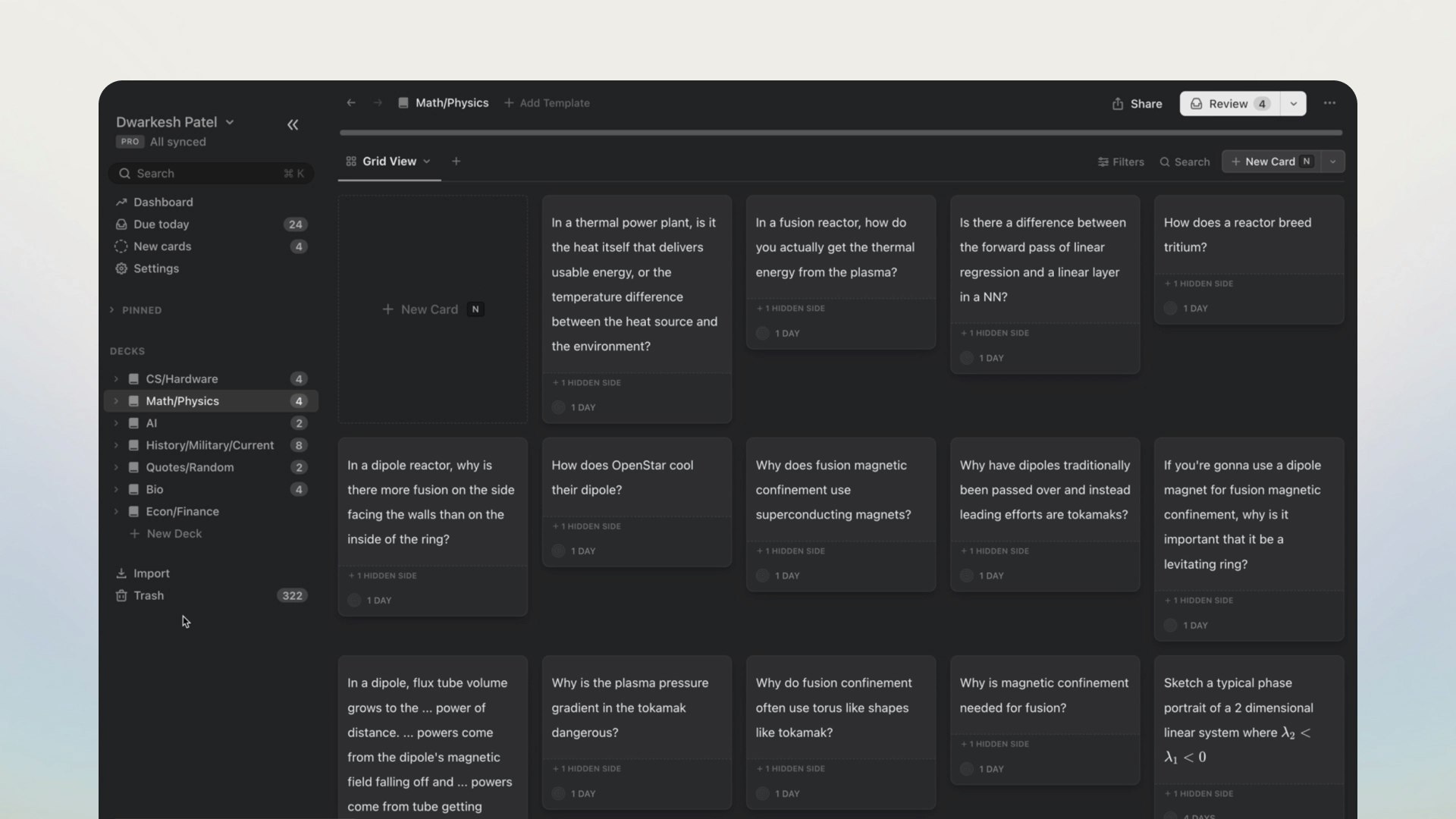
I’ve been better about this recently, though. I’ve been using different techniques to solidify each concept I encounter so that it doesn’t feel like I’m building my understanding on mud. Spaced repetition has been a huge boon. This is where you make flashcards and then put them into a program like Anki or Mochi, which will quiz you on them again and again over the course of years.
I’ve also been trying to synthesize a “hot take” whenever I learn enough about a subject. Sometimes I publish this as a blog post, other times I keep it private and just explain it to a friend. Either way, this has been a super helpful practice, because in the process of ironing out my viewpoint and connecting all the different pieces of evidence, I’m forced to straighten out how everything fits together.
But the most valuable version of this is implementing key ideas from scratch. Implementing something forces you to solidify your understanding of its submodules and how they all fit together. Some domains are particularly amenable to this: for example, if I’m preparing to interview an AI researcher and I need to understand a common class of algorithms, I can just implement the actual code. In other domains, though, I have to make do with lossier mechanisms — blog posts or spreadsheet models — in an attempt to recapture that same pedagogical value.
At this point, whenever I’m reading something, or even just talking to someone, I’m in this mode where I’m trying to pinpoint what I don’t concretely understand and then trying to understand it more deeply. The podcast has really trained me to not make assertions myself, but rather to invite my guest to make a point so that I can then push back or clarify as needed. This has become so embedded in how I communicate that a couple friends have told me that it feels like I’m interviewing them when we have a conversation.
Implementing something forces you to solidify your understanding of its submodules and how they all fit together.
The thing that makes me good at this job is that I get bored super fast — I’m extremely impatient with vague and banal points — and this motivates me to ask questions which I genuinely find interesting, or which I think are specific enough to elicit concrete insight from the guest. But it also means that I actually find intellectual conversation in my social life tedious and frustrating. Partly because it tends to be more surface level and partly because having deep conversations is my job — I need socializing to be a more light-hearted escape.
I spend a lot of my day in a state of confusion, trying to understand what experts may consider a basic point. Concretely, this involves lots of pinging back-and-forth with LLMs: “Why is that?”, “What do I read about that?”, “This paragraph makes no sense to me, can you give me context so I can understand it?” A few times a week, though, I feel like the knowledge breaks through: I understand the point, or how the thing works, or how something fits into a larger theme within the field. I have to tread a lot of water between those moments. But if I persist through a week or two of this effort, I can usually understand a topic well enough to elicit insights from a world-expert, even if I don’t have those insights myself. And then I choose a new domain and start the whole process over again.
Related reads