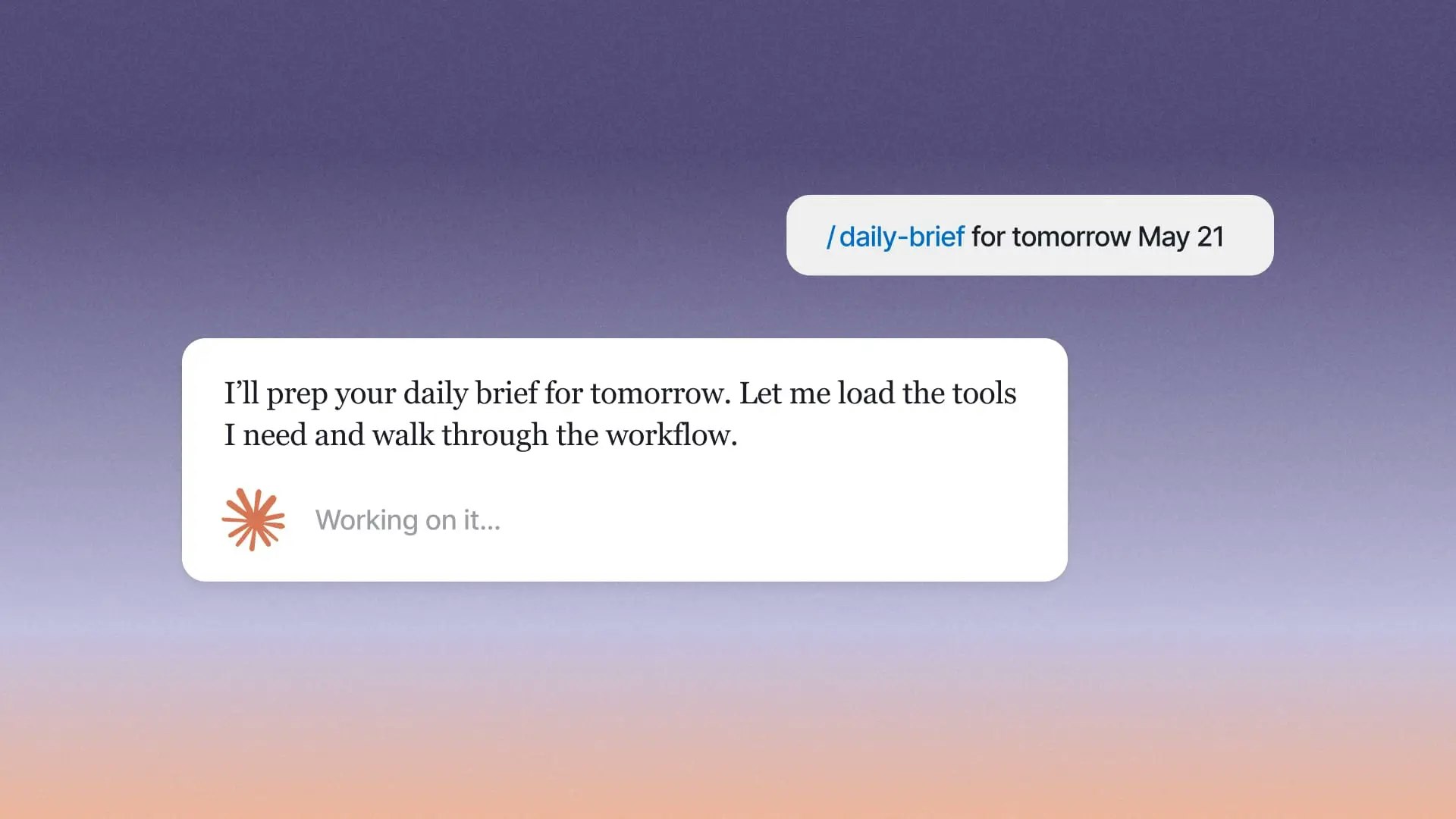
Many teams use AI to research their market and prospects. Andrew Linford, who runs operations at resource planning startup Mosaic, is rethinking the order of operations. By connecting Claude via multiple MCPs to Salesforce, Gong, Slack, Gmail, Notion, and Octave, he’s created a “chief of staff” of sorts that has the knowledge to make recommendations that can help move specific deals along.
In our conversation, three tactics stood out:
1. Turning Claude into a hub of institutional information and data, rather than using it as a search engine.
Call transcripts, CRM history, emails, and account notes often contain more nuanced, useful information that may not be available publicly.
2. Combining structured and unstructured information.
Salesforce fields, renewal data, and contact records sit alongside transcripts, Slack conversations, and email threads.
3. Treating AI as a system, not a chatbot.
Linford has created a virtuous cycle whereby Claude is iterating on code itself, to create repeatable workflows that self-improve.
Linford recalls the days of having to make tradeoffs when it came to data management. “A few years ago, we were mostly focused on organizing data,” he says. “Now, with LLMs and MCPs, we have way fewer constraints around the amount of data we’re working with or where it’s coming from.”
Today, Linford includes all of the following kinds of data in his training of Claude:
Structured data
Customer records
Renewal information
Pipeline history
Unstructured data
Call transcripts
Email threads
Meeting notes
Company knowledge
ICP research
GTM strategy
Messaging frameworks
All this information contributes to the “skilled daily brief,” as Linford describes: “This brief is set up for every sales rep to run in the morning and give them an overview of all of their different upcoming meetings at a very high level. If it’s a day where they don't have that many meetings, it then surfaces different opportunities to follow up with people.”
Here are some examples of deliverables that Linford’s Claude instance is set up to provide:
Top accounts to follow up with
Account-specific pre-meeting notes
Stalled opportunity recommendations
Closed lost revival opportunities
Outreach drafts with specific contact details for all of the above
Account health for each rep, including at-risk deals
Overall pipeline analysis and progress against goals
Linford also has steps in place for Claude to keep iterating on its outputs. Rather than manually updating prompts and instructions, he records feedback conversations with sales leaders on ways for these briefs to improve, feeds those discussions into Claude, and asks it to identify what should change in the underlying workflows.
For example, if a pre-meeting brief generated by Claude is too long, misses important context, or fails to incorporate Mosaic’s positioning framework, Linford can provide feedback and have Claude revise the skill itself. The next time a rep runs that workflow, the output improves automatically.
“An LLM is going to do a much better job of writing for an LLM than a human is going to write for an LLM,” he says.
Here, Linford shows this skill file and where he intervenes versus letting Claude write:
Linford recommends starting with something simple, and working your way up in complexity. “Eventually, the power in this lies in creating a hub for multiple sources. But I’d recommend starting with something that doesn’t use external sources. That way you’ll figure out the flow and can add on later,” he says.
Andrew is an editor and content marketer at Mercury, bringing his storytelling perspective from tech brands like Dropbox and PagerDuty and long-ago banking experience at Morgan Stanley. He’s based in San Francisco out by Ocean Beach.
AI products may cost very little to run, but that doesn’t mean they should be priced cheaply. Here’s how founders can price based on value, instead of infrastructure costs.
Even if you’re an expert at juggling growth manually, what has worked for you at 10 customers won’t still work at 100 or 1,000 customers. It could be time to automate.