The new economics of starting up in 2026

Stories at Mercury; Editor in Chief, Meridian
Today’s founders are building without waiting for perfect conditions. Rather than sweating the seemingly ever-present uncertainty, they’re finding leverage in new technologies, making disciplined decisions about where their money goes (and comes from), and adjusting their plans as economic conditions evolve.
To better understand the sentiment and strategy behind the dollars and cents of early-stage companies today, we surveyed 1,500 U.S. founders and startup operators building companies under six years old. The throughline? They remain remarkably optimistic about their own businesses, even as they become more disciplined about where they spend, how they raise, and what they expect from technology. And the startups embracing AI most deeply are increasingly operating under a different set of economic realities than everyone else.
Methodology: This report is based on a May 2026 online survey of 1,500 U.S. adults who had been involved in starting a company in the last six years. The sample was provided by Sago, a research panel company. Numbers are rounded to the next whole digit; percentages may not add up to 100%.
2026 startup economics in 60 seconds
To kick off, here’s a look at some top-level trends amongst today’s early-stage companies:
- 95% have deployed AI agents
- 83% intend to increase their use of stablecoins in the next year
- 84% were more confident in their business this year
- 80% have made business changes in response to economic factors
- 77% increased AI spend year over year
- 75% say costs of running a business are higher than they expected
- 24% postponed business investments due to increased costs and economic factors
- 12% reduced staff due to higher operating costs
We’ll dig in further on some of these stats below.
Vibe check
At a glance, respondents seem to present a fairly rosy picture. But break things down and it gets a little more complex.
- 84% of respondents are feeling improved confidence in their business prospects year over year — a seemingly minor change from last year’s 87%, but…
- The chunk of respondents who said their confidence had “significantly improved” fell from 41% to 33%, while “somewhat improved” climbed from 46% to 51%.
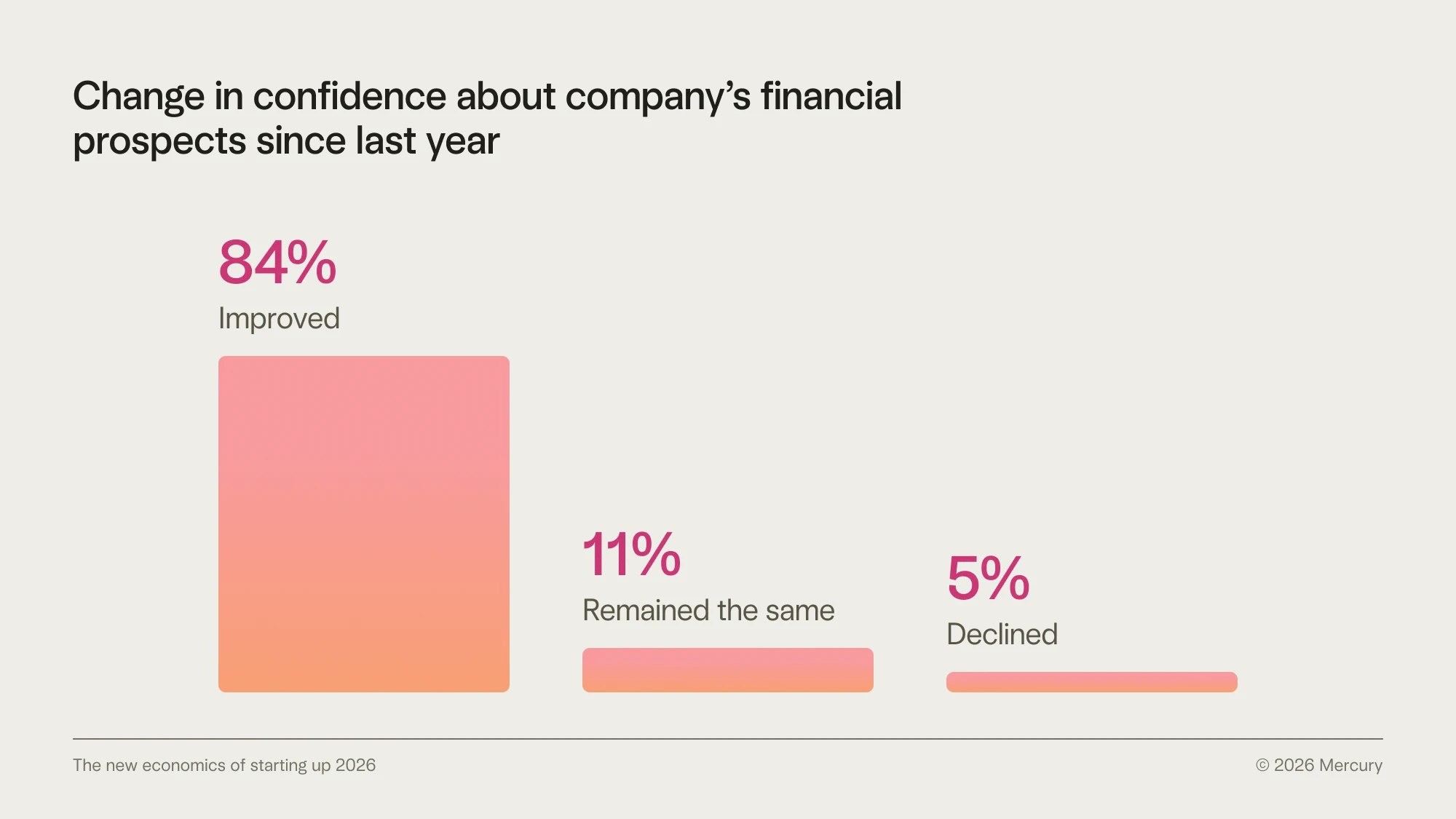
It’s not earth-shattering, and the general picture is pleasant, but it does point to a bit of cooling in sentiment. (Spoilers: You’ll see more of this tempering in the numbers in this report.)
Like last year, AI adoption reveals a striking confidence gulf: 91% of significant AI adopters report improved business confidence versus 60% for non-adopters — a whopping 31-point gap.
91%
of significant AI adopters are more confident in their business this year versus 60% of non-AI adopters
This confidence (AI-inflected or not) matters on all kinds of levels — including around personal paychecks. While the large majority (81%) of those whose business confidence improved year over year pay themselves a market-rate salary, only 56% of those with stagnant or declining confidence said the same. In an interesting near-parallel, 80% of AI adopters (those who are actively using AI within their business) pay themselves market rate salaries, versus 57% of non-AI adopters.
80%
of AI adopters pay themselves a market salary versus 57% of non-AI adopters
First-time founders were more likely than repeat founders — 79% versus 66% — to pay themselves at market rate; men, 82%, were more likely than women, 63%, to say the same.
Now, let’s get back to the vibes. Beyond the AI correlation, what’s influencing how those founders are feeling? For the most part, they were factors related to their own business’s performance (38%) and operational efficiency (24%).
For the small number of respondents with declining confidence (a mere 5%), macroeconomic factors come more heavily into play: 51% cited them, compared to just 7% for those whose confidence increased. And perhaps worth noting: that decline in confidence isn’t quite even-handed. Gen X and Boomer respondents report confidence declining at 9% versus just 2% for Gen Z and Millennials, signaling that older founders might be taking a slightly more cautious view of the road ahead.
Inflation also brought an increasingly negative vibe — more than half of respondents (51%) said it has negatively impacted their business this year, versus 36% last year. (But we've got some interesting breakdowns on this later.)
The cost of doing business
In a year where inflation and rising consumer costs have been omnipresent, maybe it’s no surprise that business costs keep running ahead of expectations.
75% of respondents reported that running a business cost more than they expected — up from 66% in 2025. First-time and repeat founders were pretty much equally surprised, perhaps signalling that this is not just about a given founder’s personal experience and knowledge. Literally zero (!) respondents said costs were much lower than expected.
AI economics
A slice of the conversation here comes back around to AI, with the costs of implementation continuing to rise alongside other business expenses. Overall, 77% of respondents said AI and token spend increased over the past year. Most frequently (30%) respondents said their costs had gone up 25–50%. 13% of tech companies said spend had gone up at least 100%; a small slice (4%) of significant AI users noted that costs had gone up a whopping 200% or more in the past year.
What do those numbers wash out to? For the early-stage companies surveyed, less than a percent of those with fewer than 100 employees spent over $100K a year on AI, but that jumps to 7% past 100 employees. Tech companies were the heaviest spenders, with 16% spending between $25–100K per month, and 6% spending more than that.
Some concrete numbers
To get a little more granular, we also took a supplemental look into Mercury’s own data to see how AI spend has changed dollar by dollar for smaller companies (~50 employees or less) incorporated in the last six years.
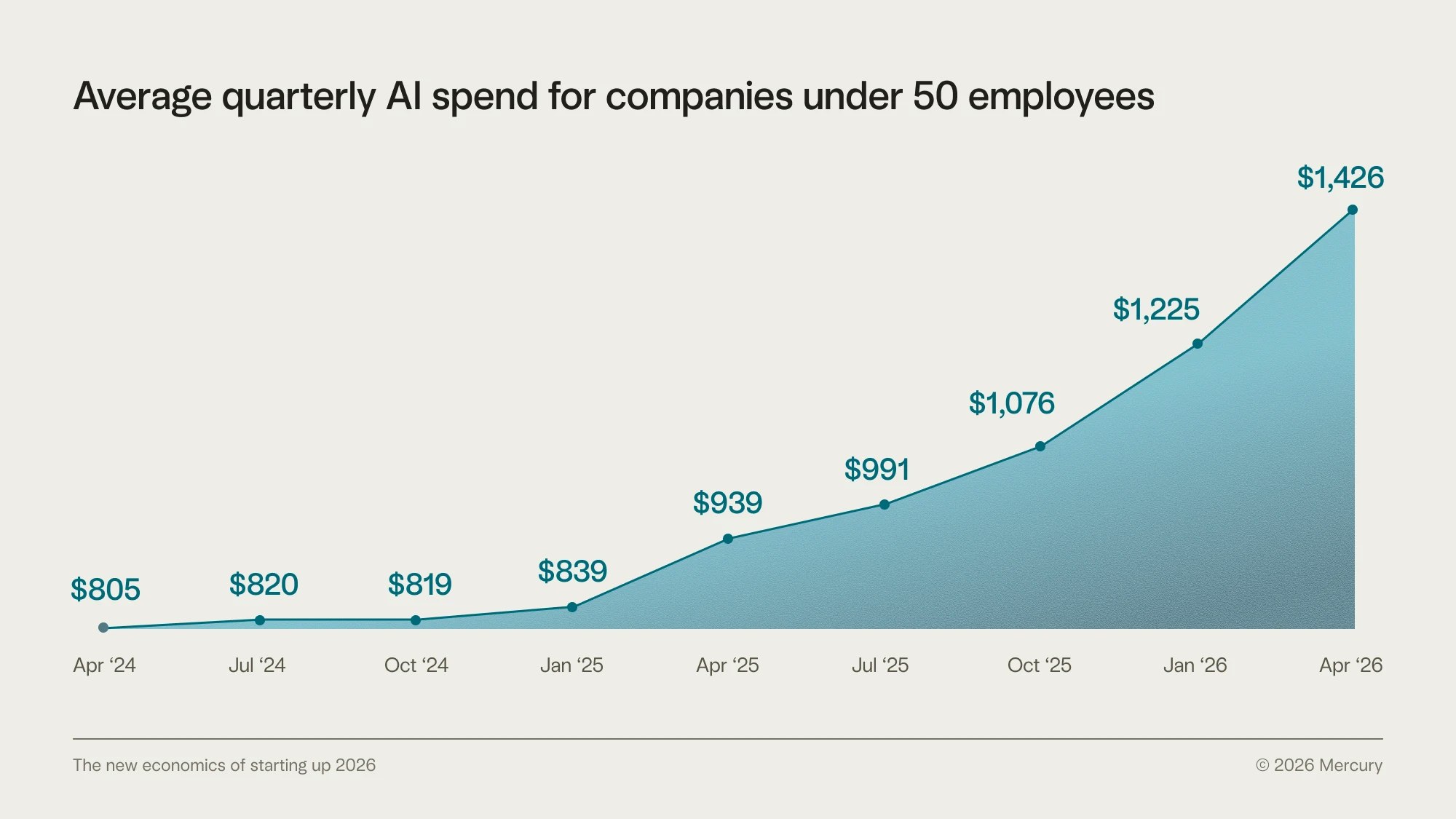
From April 2025 to April 2026, we saw average monthly AI spend increase over 50% — a percentage influenced by a higher proportion of tech companies in our mix than amongst survey respondents. Add another year to that timeline, stretching back to April 2024, and the increase is just over 77%. To boot, micro companies — those with less than 10 employees or annual revenue under $25K — had less dramatic increases on average, which naturally pulls this average down; when we looked at larger companies, the spikes were even more sharply up and to the right.
Now, getting back to the survey — here’s a closer look at respondents’ AI spend.
Monthly spend on AI products per month, by annual company revenue: <$1M–5M
For the most part, smaller companies spent less and bigger companies spent more. To underscore the former, among sub-$1M companies: 5% spend $25K+ and 17% spend nothing.
Total monthly AI spend | <$1M | $1–5M |
|---|---|---|
Over $100,000 | 1% | 1% |
$25,000 – $100,000 | 4% | 7% |
$5,000 – $25,000 | 13% | 33% |
$1,000 – $5,000 | 31% | 42% |
Under $1,000 | 34% | 12% |
We don’t spend money on AI products | 17% | 5% |
Monthly spend on AI products per month, by annual company revenue: $5M–10M+
Among $10M+ companies, 30% spend over $25K/month on AI, and a mere 1% spend nothing.
Total monthly AI spend | $5–10M | $10M+ |
|---|---|---|
Over $100,000 | 2% | 6% |
$25,000 – $100,000 | 18% | 24% |
$5,000 – $25,000 | 34% | 43% |
$1,000 – $5,000 | 37% | 20% |
Under $1,000 | 8% | 6% |
We don’t spend money on AI products | 2% | 1% |
By industry, we see some other trends — with tech companies 6x more likely than other industries to spend over $100K a month on AI.
Despite the costs, the large majority of those spending on AI (87%) are confident they can maintain current AI capabilities without raising prices for customers or cutting their costs elsewhere. (That’s not quite how they’re handling other inputs, though, as you’ll see later in the report.)
AI anxiety (and not)
The perception of AI’s ROI held steady year over year, with 85% of relevant respondents saying their AI tools had better ROI than traditional alternatives. (Last yearOpens in new tab that number was 83%.) So it goes that 65% are at least somewhat concerned that AI vendor disruption — such as price changes, terms shifts, or shutdowns — could significantly harm their business. And the more AI respondents use, the more acute that gets: significant AI adopters are 3x as likely as their more moderate adoption counterparts to be very concerned about vendor disruption (19% versus 6%). Perhaps this has something to do with a lack of diversification across vendors: 29% of respondents said over half of their AI reliance is on a single vendor; another 37% tick in at 25–50%.
Concern about AI vendor disruption generally scaled with revenue.
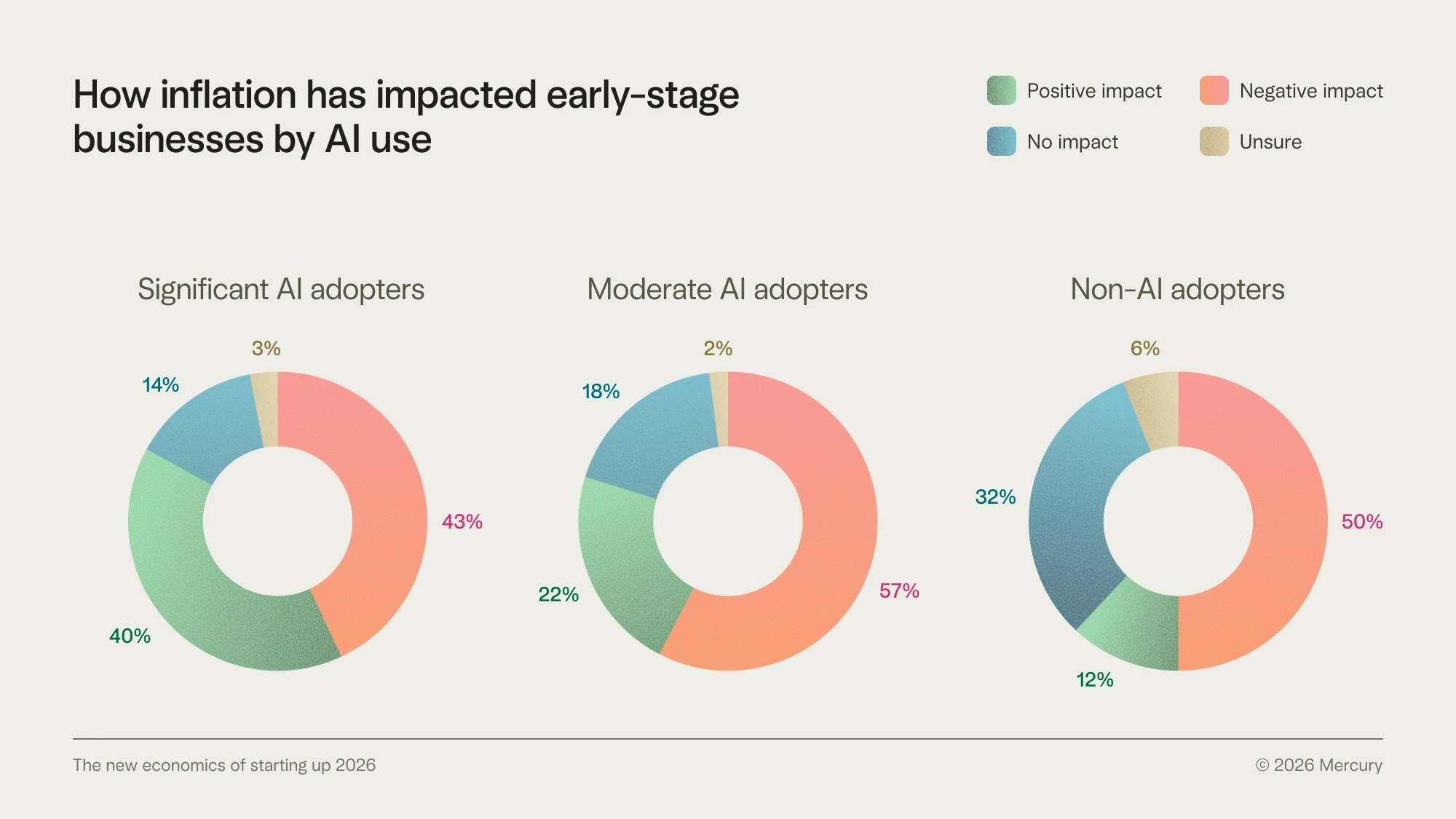
40%
of significant AI adopters say inflation affected their business... positively
That said, here’s a quick, intriguing side bar: Significant AI adopters seem to process inflation differently than their peers. In fact, 40% of significant AI adopters say inflation affected their business positively, versus just 12% of non-adopters. (Caveat: 43% of those same AI adopters said inflation had a negative impact — so it’s certainly not all sunshine.) Might it be that AI-powered companies are better positioned to turn inflationary pressure into an advantage, while slower-to-adapt competitors are stuck absorbing the hit?
Dealing with rising costs
We saw earlier in the report that respondents largely didn’t think they’d have to mess about increasing prices or cutting costs due to AI. But when it comes to balancing the impact of inflation, economic pressures, and the rest of the costs they face, early-stage companies seem to be taking some different approaches.
Here are some of the ways respondents are adapting:
- 27% passed costs to customers and/or absorbed costs in margins
- 26% held onto more cash than usual as a buffer
- 25% switched suppliers or are actively sourcing alternatives
- 24% postponed or canceled a planned investment (e.g., hiring, equipment, expansion) or tried to get ahead of it by building up inventory ahead of expected tariff changes
Customer reactions
Of those who passed costs along to customers, 68% did it to the tune of 5–10% increases — something most of us who’ve bought anything or used a service this year are probably unsurprised by.
And how are customers reacting to these changes? 90% of respondents had noticed some kind of change in customer behavior — either downstream of their own actions, their competitors’, or the wider economic landscape. Respondents reported things like increased pushback on pricing (31%), customers downsizing orders (26%), customers leaving for cheaper alternatives (26%), and longer payment cycles (25%). On the more positive side, in fields like Tech (28%) and Manufacturing (26%), some saw larger contracts or orders. And, across industries, when competitors raised prices, some respondents (28%) even found themselves with new customers.

Team building
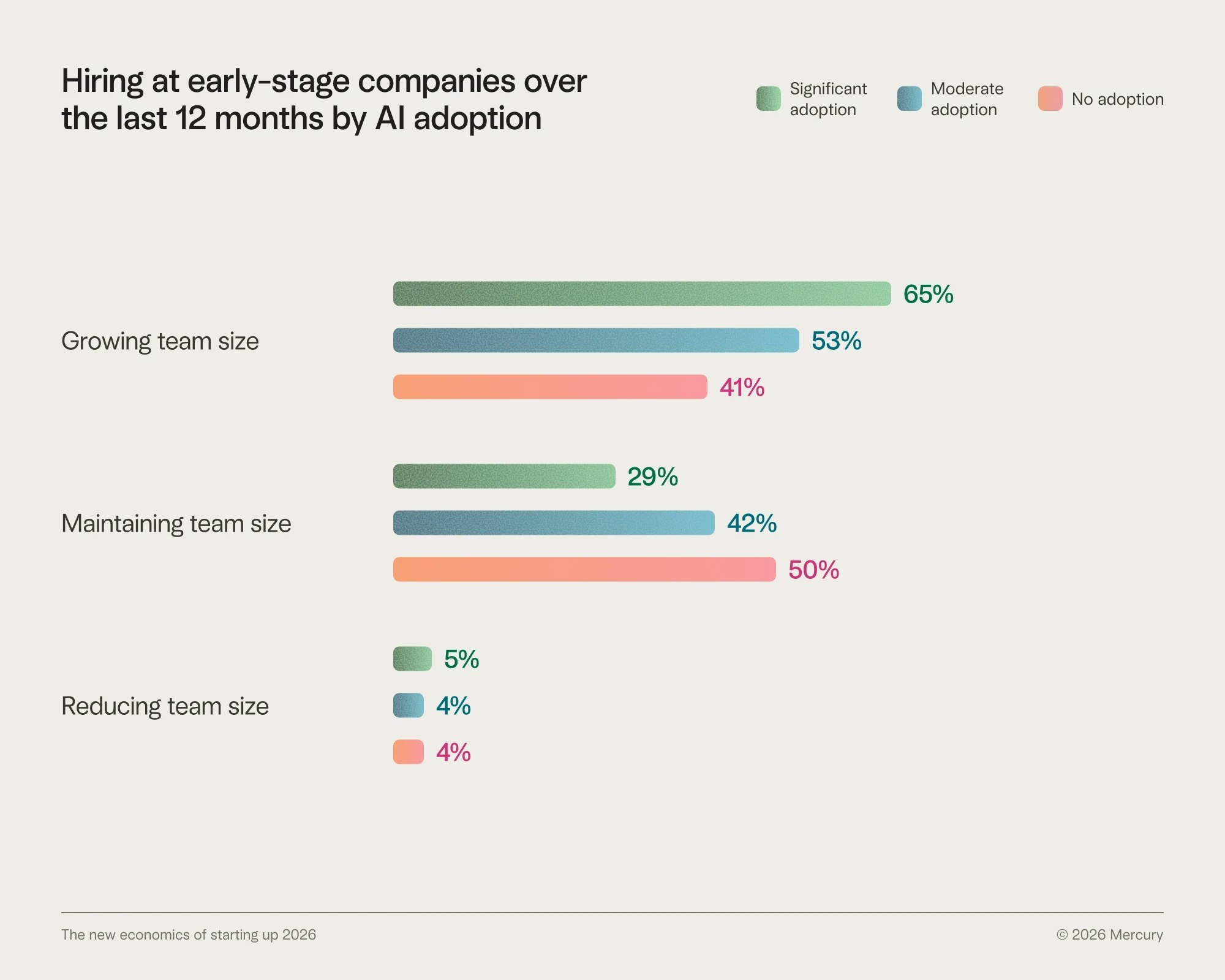
We asked respondents about hiring — were they actively growing their teams, hiring for select roles, keeping things steady, reducing their staff? While not in freefall like some headlines would have us worry, hiring growth does seem to be cooling a bit amongst these early-stage companies: The number of respondents who said they were actively scaling team size fell from 32% to 24% year over year, while those maintaining current team size grew from 34% to 38%. There was notable correlation between business confidence and more hiring: 32% of those whose confidence in their company significantly improved year over year were actively scaling versus just 10% of those whose confidence was flat or declining.
Who’s hiring?
Still, you can hardly talk about team size and hiring right now without talking about layoffs. So — let’s talk about them. The heartening stuff: Like last year, hardly anyone was actually reducing team size. In fact, the bulk — 94% — were either maintaining current team size (38%) or still hiring (56%) to some extent, whether selectively for key roles or actively scaling.
That said, this survey asks about a year’s worth of activity, not just where companies are today. And 12% of respondents said that sometime in the past year, they had laid off or reduced staff expressly due to the higher costs of doing business; significant AI users (14%) indicated this at almost double the rate of non-AI users (8%).
But it’s probably not time to panic that AI is killing all the jobs: Despite a meaningful drop from last year’s 79%, 56% of companies incorporating AI still say they’re hiring more because of AI while 38% said it’s allowing them to hold hiring plans steady. That covers 94% of relevant respondents.
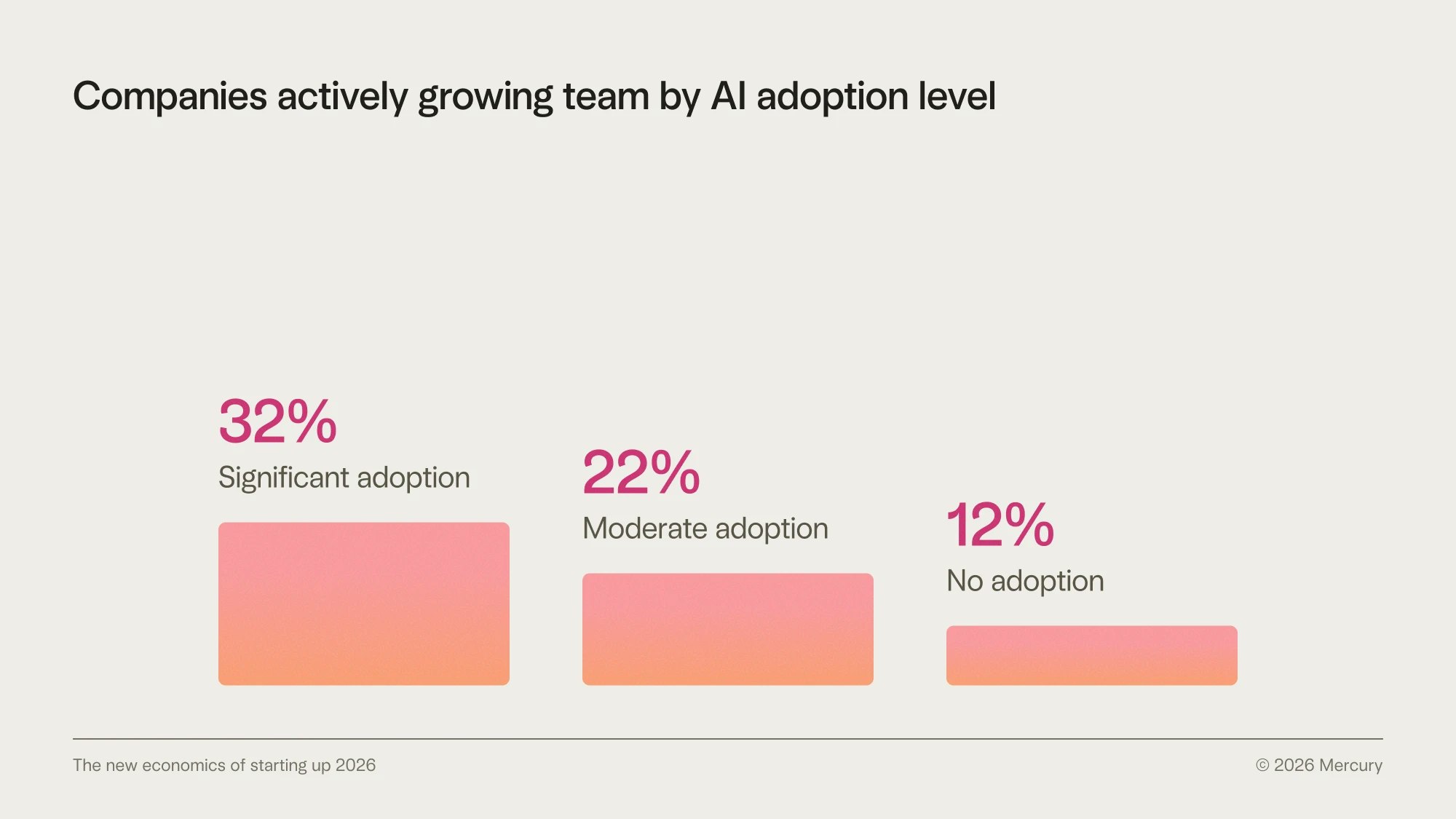
As well, the higher a company’s self-reported rate of AI adoption, the more likely they were to be actively scaling their team size.
What will happen to entry-level workers?
The rise of AI has also been widely discussed (and anxiously lamented) as a “replacement” for junior workers, raising alarm bells about job prospects for younger workers and the long-tail of hiring and career pipelines. But for these early-stage companies, those worries aren’t quite translating into reality. In fact, when asked how AI was impacting their hiring of earlier-career employees (those with 0–3 years experience), there’s actually a small tilt in favor.
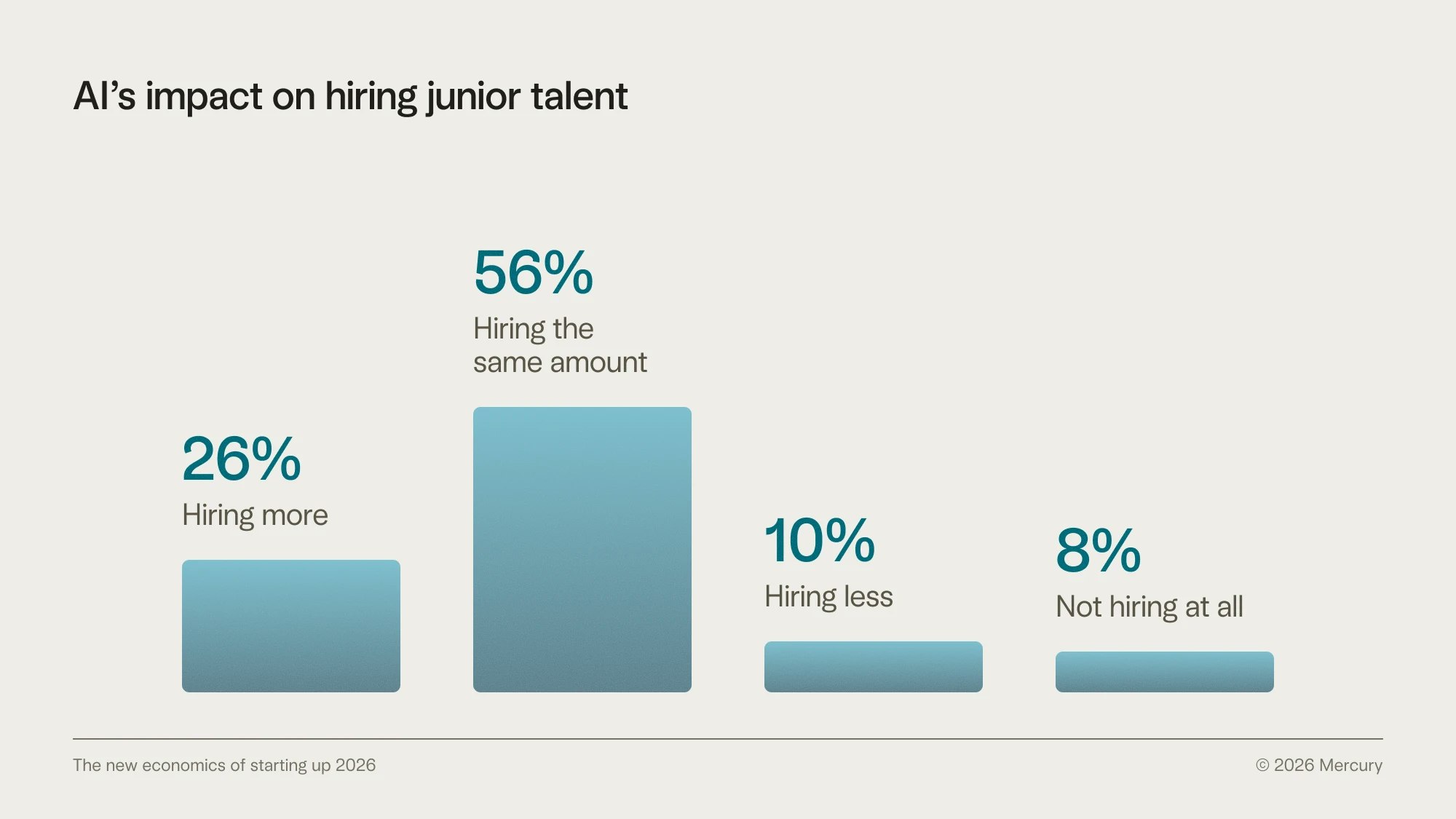
All told, 82% of early-stage companies report hiring the same or more junior talent than they would have without AI.
Moreover, respondents who reported significant AI adoption were twice as likely as their moderate-adoption counterparts to say they were hiring more juniors... thanks to AI.
New hires, new requirements
AI also seems to be reshaping hiring more broadly at early-stage companies. 82% of AI-adopters have made changes to compensation or role structure due to the use of AI tools, and companies across the board were making adjustments:
- 34% have introduced AI fluency as a job requirement. (This spikes to 51% in Tech.)
- 28% of respondents have shifted some full-time roles to contractor+AI combos
- 25% of respondents are paying lower salaries for roles AI can support. (Most common in Manufacturing, 35%, and least common in Tech, 21%.)

Making business possible
From funding to tooling, all kinds of things play a role in someone’s ability to start (and scale) a business. Here’s a look at what’s shaping the possible for these early-stage businesses.
Did AI make your business possible?
We’ve all heard the buzz around vibe-coded apps and AI pulling the starting line forward for founders. But what’s the reality?
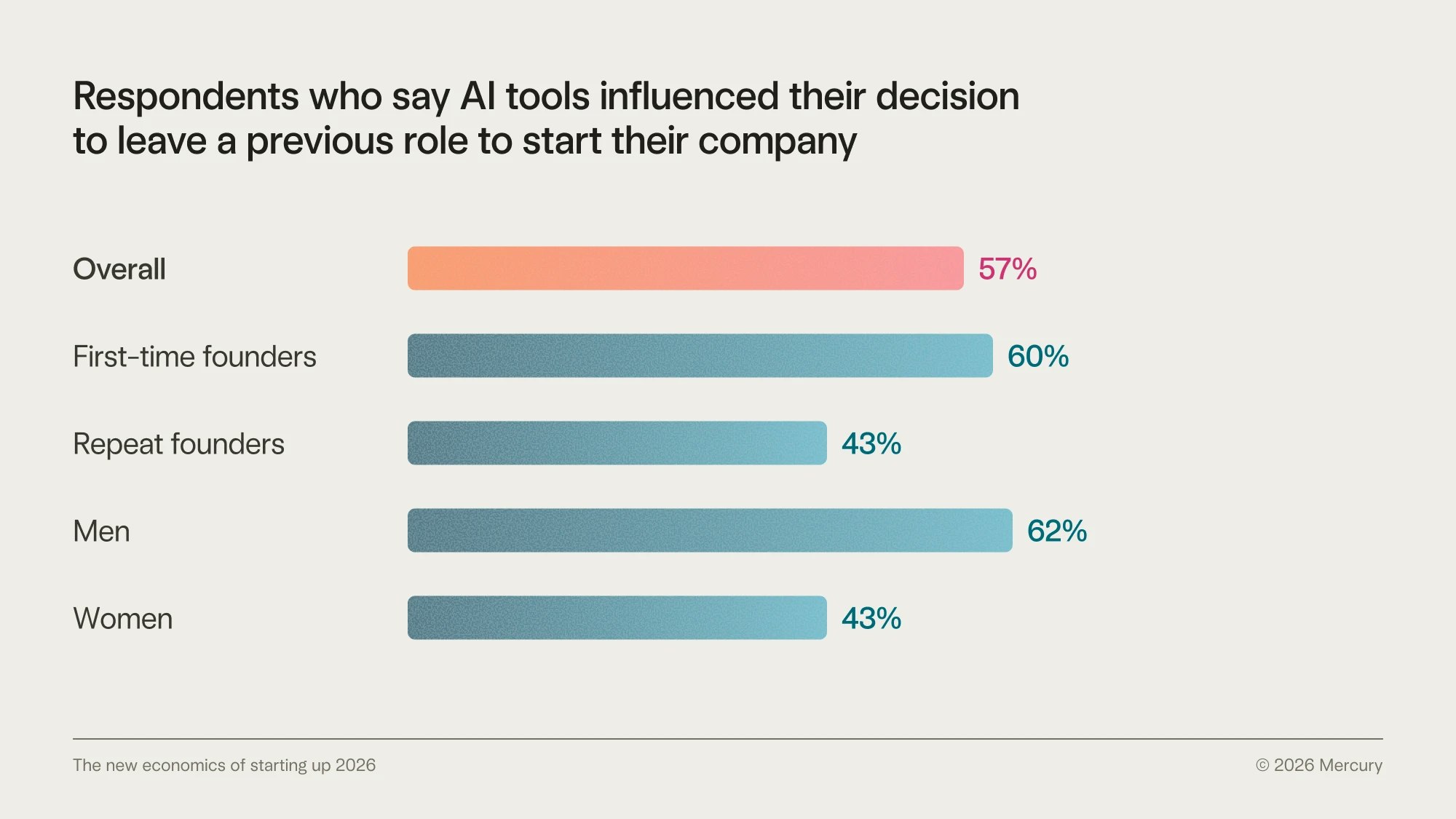
57% of respondents said that the availability of AI tools influenced their decision to leave another company to start their current business. This was more common amongst first time founders (60%) than repeat founders (43%), and men (62%) than women (43%). (9% of respondents didn’t leave another company to start the one they were surveyed about.)
Moreover, some respondents said they wouldn’t have started their companies at all without AI tools. While numbers vary by industry and scale, a notable 31% of respondents running early-stage companies with $10M+ revenue — the highest revenue cohort in the survey — say AI literally made starting their business possible. Yes, some would have started their business regardless, but 43% of respondents concede that while they would have done it with or without AI, the latter would have been slower or required more money.
Raise a round
For some other buzzworthy chatter: Headline after headline and anecdote after anecdote this year have indicated that founders are facing challenges accessing venture capital — and word on the street is those challenges have extended to accessing cash from traditional lenders, too. Perhaps it follows that of all the capitalization sources we asked about, self-funding was the only one that respondents reported more of year over year.
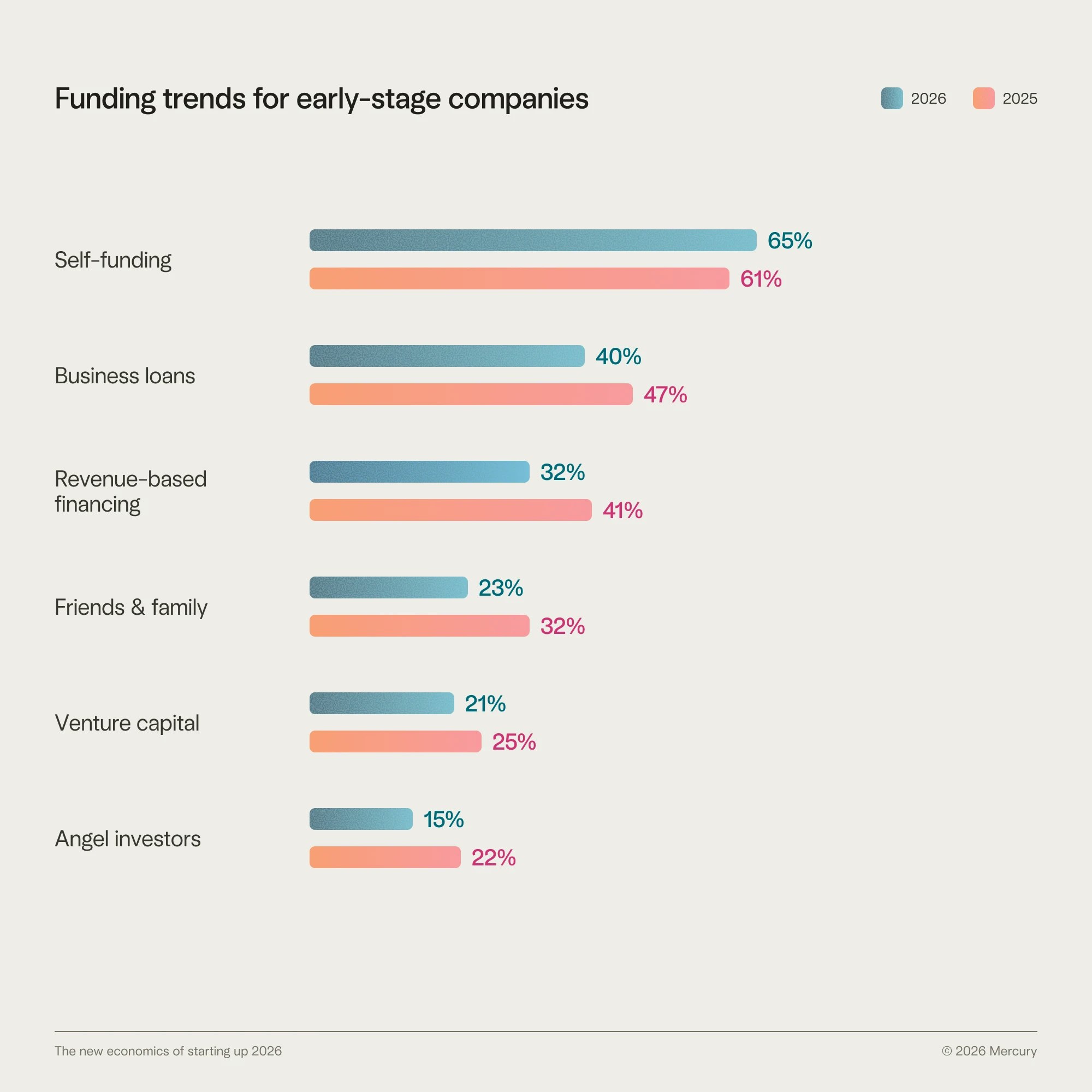
While there are sources like Pitchbook and Crunchbase that can provide harder numbers on venture funding, we saw some interesting self-reported signals from respondents:
- Gen Z and Millennials (23%) were more likely than older generations (15%) to raise venture capital this year
- Significant AI adopters were more than 4x as likely to have raised venture capital as non-AI adopters (31% versus 7%)
- AI adopters also raised bigger rounds than non-AI adopters on average. (For example, of those who raised VC money, they were more than twice as likely to bring in at least $1M in their last round — 72% versus 35%.)
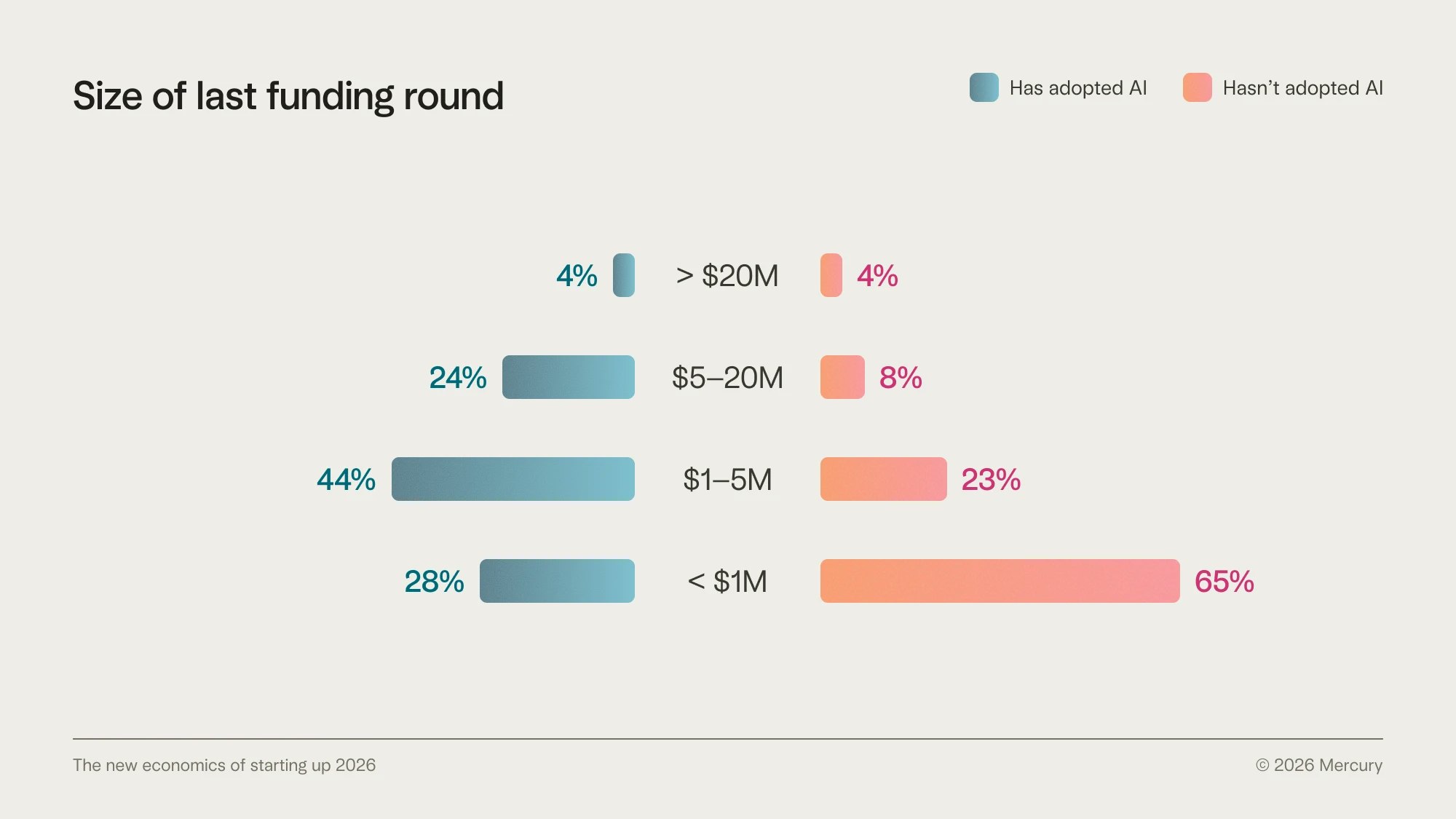
And, well, money isn’t free. Of those who’d raised a round of venture capital, 47% spent between $15–50K on legal, accounting, and compliance costs — a reminder that closing a funding round doesn’t just put cash in the bank, but also brings with it the costs of becoming a venture-backed company. For many, the costs of those rounds came with trade-offs: 43% delayed or forewent a marketing investment, 42% did the same hiring an employee, 40% a product launch, and (gulp) 37% paying themselves a salary.
37%
delayed or skipped paying themselves a salary due to the administrative costs of a fundraising round
On the other hand, 23% of founders turned away investment in the past 24 months, most often $100–500K (42% of turned-away amounts were in that range). The most common blocker, by just a hair? Hitting the $100K crowdfunding audit threshold (36%). 33% of respondents ran up their maximum investor count, and 35% had to leave money on the table after an interested investor’s fund had restrictions preventing the investment.
As companies grew in headcount, the likelihood of turning away investment scaled linearly. And, the “AI divide” came through again — AI adopters were more likely (25%) than non-AI adopters (9%) to have had to turn investment away.
Everything’s coming up agentic
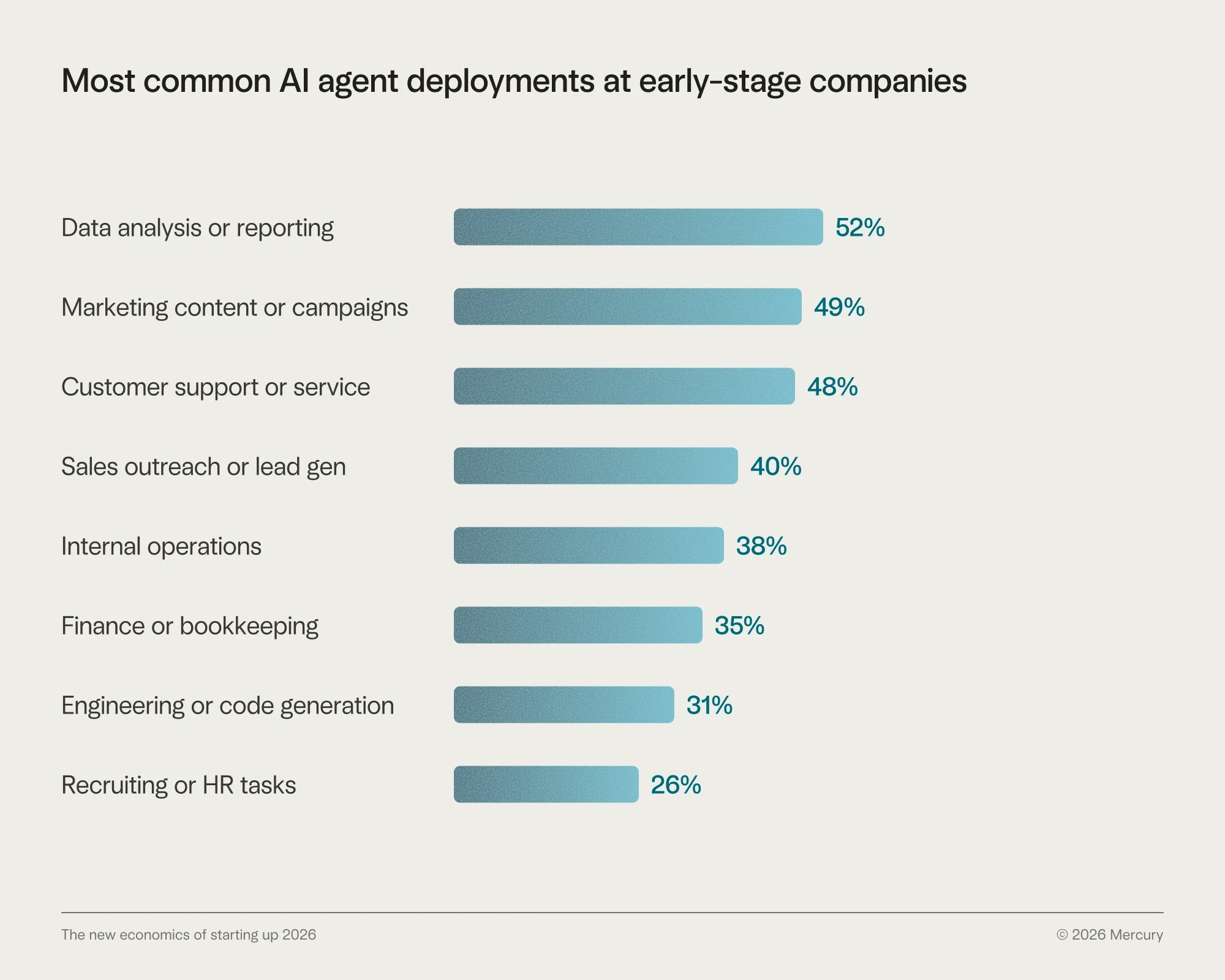
Rather than just adding headcount or automating individual tasks, AI-enabled workflows look to be in vogue — and creating new degrees of leverage. In practice, that looks like nearly every early-stage startup surveyed deploying AI agents.
95%
of early-stage companies have deployed AI agents
Indeed, 95% of respondents said their companies had done so, with an additional 1% piloting them but not yet deploying. Once companies broke into the 100+ employee range, not a single one had no agents deployed.
They were most likely to be using AI agents for data analysis and reporting, marketing, and customer support.
Summary
Across the survey, no matter how we sliced things, AI was the force that kept showing up as a dividing line and differentiator. The respondents whose companies were adopting it most were consistently more confident, raising larger rounds, experiencing inflation differently, and more. While it’s not possible to separate true cause and correlation in all instances here, the pattern is difficult to ignore: AI increasingly appears to be tied to a distinct economic advantage for early-stage companies and startups.
All in? The economics of starting up haven't been rewritten overnight. But they are changing — and the founders adapting fastest are already beginning to play by a different set of rules.
Thank you to Kate Apostolou, Stephanie Baumann, Catherine Aquilina, Adam Berg, Celeste Carswell, Sandra Chu, Katie Dolan, Megan Duffy, Jordan Horsman, Amy Kirkham, Dani Moalem, Rachel Oatway, Prateek Parashar, Tamara Rahoumi, and Dan Swislow for contributing to this report.
About the author
Stories at Mercury; Editor in Chief, Meridian
Share article
Related reads

Dynamic pricing strategies for your ecommerce business

The future belongs to the tinkerers

Ctrl-Z-the-world