The feeling beyond the feature
The camera on your phone would have seemed like science fiction to a professional photographer a mere 20 years ago. Then, top-of-the-line digital cameras lacked viewfinders, required massive storage space for a handful of images, and could cost, in some cases, tens of thousands of dollars. Today, with a lens smaller than your fingernail, most smartphone cameras can capture 48-megapixel images with optical image stabilization, feature computational night modes, and can shoot 4K video — all in a device that fits in the pocket of your jeans.
But, almost two centuries after the daguerreotype ruptured how people thought about images and documentation, and 100 years after film cameras became commonplace, there’s a growing discontent with digital photography — because the final product is almost too good. The images are hyperreal: sharper than memory, yet somehow less vivid than the moment itself. Each experience, viewed through the screen, is redoable (and thus disposable); the next is always a tap away. We all have thousands of photos taking up storage space in the cloud, and little space in our hearts.
To many of us, a ‘better’ product is about experience more than the spec sheet.
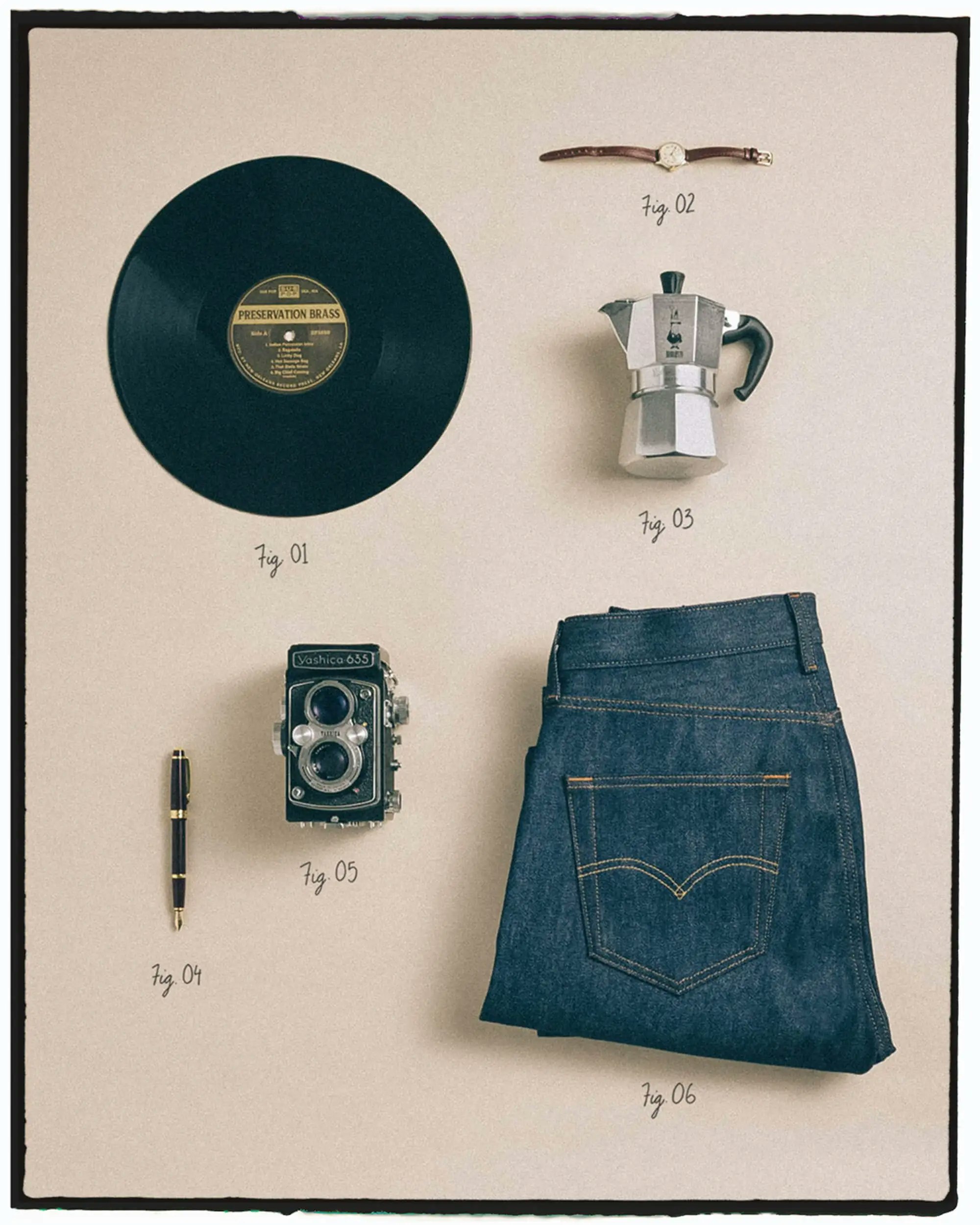
Which may be why film, once thought to be approaching mainstream obsolescence, is in revival. Anecdotally, more people are choosing to shoot on a medium with higher cost, lower resolution, and zero instant feedback, content to wait days (or at least hours) for prints to come back from the lab. The film camera experience is undeniably sensory: the mechanical whir of the shutter. The grain. The moment of opening an envelope and seeing, for the first time, the image captured.
But film is not unique in seeing a mainstream revival despite technological innovation that theoretically might have rendered it obsolete. Vinyl sales have risen for over a decade, even as Spotify put every recording ever made on your phone for $13 a month. The moka pot — designed by Alfonso Bialetti in 1933, essentially unchanged since — is experiencing a recent resurgence in sales, even when competing with digital machines that will grind, brew, and have eight cups waiting before your alarm goes off.
Nostalgia is surely at play here. But more crucially, the people choosing these things aren’t doing so because of the increments they make toward traditional visions of technological or engineering progress. To them, to many of us, a “better” product is about experience more than the spec sheet.
For the last two centuries, efficiency has seemed to be an obvious bargain: we traded craft for scale, handmade for mass-produced, frills for function. We welcomed this cheaper, easier-to-produce world with open arms. Our clothes weren’t tailor-made for our bodies, but we had more of them, and (eventually) we could order them through the mail, and then the internet. Our food became more processed (not to mention industrial-scale farming’s immeasurable environmental impact), but it rotted less quickly, fewer people had to spend the day tilling the fields to get it — and more people could be fed.
Software accelerated this atomic efficiency to the world of bits. When personal computing went mainstream in the ’80s, software (and hardware) was designed to prioritize speed and efficiency because of the severe limits of the era’s hardware. The deal was simple: tolerate the ugly command-line interface and small storage space in exchange for velocity. As hardware got better and more frictionless, mainstream internet emerged and got faster and faster, and more digital possibilities became instantaneously available with a simple key stroke, efficiency became the lens through which we evaluated almost everything.
Read more about what makes an enduring product:
But if the moka pot, the film camera, and the record player are representative examples (albeit not of software), efficiency isn’t everything. Perceived constraints — 36 exposures on a roll of film, having to flip a vinyl record halfway through, a moka pot that can’t be set and forgotten — create intention. Intention creates meaning. And meaning, in a world optimized for effortless consumption, turns out to be surprisingly hard to come by.
If these trends of analog resurgence are any indication, perhaps the products, the tools, that inspire the most loyalty are the ones that have a texture, a point of view, a way of shaping how you do things that makes you more of who you want to be. They are tools that ask you to care, and give you something in return. If we bring this back around to computing, this desire for texture and intention is underscored by people’s preferences around emerging AI models. When efficiency gaps between models close, the conversation about which AI model to use should focus less and less on capability and more on which one unlocks a user’s point of view.
Notion — the now-ubiquitous productivity software that allows users to custom-build pages and workflows — enjoys a vocal, engaged user community in part for this reason. There are simpler tools that do most of what it does, so Notion pitches the opposite: the personal over the maximally efficient. It doesn’t force a default setup, prescribed workflow, or insistent fast track from A to B. Instead, it gives users a blank canvas. And, while it offers plenty of templates that can make things effectively instant, what you’ve built does not have to be one size fits all. It feels like it is yours once you set it up. Notion asks something of you, an investment of thought and time (indeed, it could take weeks to build a system that actually fits), and that demand defines the experience.
Anthropic, the company behind Claude, invites people in with capabilities, exceptional branding — and a feeling. It’s building AI with genuine character: intellectual curiosity, warmth, a willingness to push back. (Not to mention a focus on trust and ethical development.) Claude is designed to avoid sycophantic responses, to reason out loud, to feel like a mind engaging with a user’s rather than a tool returning outputs. While each LLM has things it excels at (or doesn’t), in a general sense, it shares many capabilities with its closest competitor, ChatGPT — but users who prefer Claude often do so for the texture it offers in its communication and output. It offers the feeling that it is “thinking” along with you. Despite its actual speed, its conversational output is not delivered in a way that feels like it’s prioritizing maximum concision and efficiency. For many users, this makes it feel more “real.”
Many — indeed, probably most — products do succumb to their more technologically advanced successors. But those that offer a sense of meaning and ritual seem to have a penchant for survival. Maybe the act of dropping the needle on a chosen album, having to get up to turn over the LP, or soaking in the smell and gurgle of the coffee before it’s ready, standing watch while it brews, feels more meaningful than sending a fax (which could have been an email) or using a LaserDisc player (which could have been a DVD player, or a Blu-ray player, or a streaming series). The rituals become embedded in our behavior or identity. In an increasingly digital world — and as the canopies of religion, community, and job security no longer provide the shelter they once did — we seek grounding, being together with others, and thoughtful ways to define ourselves. Tactile products that offer us ritual help support our identities while creating a site to be in communion with fellow users. And, because these products do only one thing, they give us a rare opportunity to focus in a world of always-on, multitasking pressure. You can’t doomscroll on a moka pot.
If we bring our focus to the digital world, maybe this means the AI models that last will be both intentional and ritualistic.
In an increasingly digital world, we seek grounding, being together with others, and thoughtful ways to define ourselves.
Cursor, the AI coding agent, felt transformative because it redefined the ritual of writing code, once understood as painstakingly iterating and tweaking and churning, and changed what coding is (and can be). It allows more people to claim the identity of coder; it changes that ritual into one more accessible to non-programmers (who can then develop their own next-generation rituals using only that tool).
The Browser Company’s Arc was a product designed to reinvent the web browser, and Dia, its latest iteration, brings AI right into the browser itself. Integrating AI assistance into the browser, where the user has spent years if not decades familiarizing themselves, feels like adding another layer of fluency to a familiar ritual as opposed to asking a user to open a separate ChatGPT window. Similarly, Poke, an AI assistant, lives primarily in iMessage, the place where millions communicate with friends and family, embedding itself into an existing ritual. (For many, the first action they take every morning is tapping their phone to check the group chat, a ritual in itself all about seeking connection.) The Interaction Company, Poke’s developer, has nailed Poke’s tactility. Its friendly and helpful personality, combined with its familiar form factor, feels to me the model of what AI assistants will look like going forward.
There’s also a future populated with what feels unimaginable to us right now. When Louis Daguerre unveiled the daguerreotype in 1839, everyone thought painting would wither: If you wanted to document how something looked, a camera could now do it more quickly, cheaply, and accurately than any artist, and the logical conclusion seemed obvious. But instead, painting adapted. Once the camera took over documentation, painting became a choice rather than a necessity. Artists stopped asking can I capture this moment accurately and started asking what does this moment feel like. Monet painted light. Cézanne painted structure. Whistler painted mood. The constraint turned out to be a gift.
That’s the move available now. The next object or piece of software to transcend obsolescence may already exist. It may be something familiar that takes on new value once another technology changes what it is for. It will offer more than simple efficiency or a quicker route from A to B. It will survive because, despite easier options, enough people decide it is worth caring about. Because it means something to them. Because it offers texture, ritual, and a little touching grass. Because all that means they would truly miss it if it disappeared.
Keep in touch
Subscribe to our community newsletter for monthly stories, resources, and inspiration from Meridian and across Mercury.
About the author
Ben Butler is the founder of London-based creative studio Bunsen, and editor-in-chief of Broadsheet. Born and raised in Ireland, Ben now lives in London.
Share article
Related reads
Dynamic pricing strategies for your ecommerce business
The future belongs to the tinkerers