The future belongs to the tinkerers
Sachin Benny writes the newsletter Summer Lightning and is a lead researcher at the Protocol Institute.
Vibe coding is the buzzword of the moment, and with good reason. It’s been used by everyone from longtime engineers to non-technical creatives to create interstitial products that can solve the software-shaped problems in peoples’ lives — from simple websites to complex second-brain architectures and agentic workflows that remind you to drink water. As LLMs and their context windows grow more advanced and can actually remember your prior work, you can preserve the exploration of a problem even if the app you made over the weekend doesn’t get any traction. You can just keep building until you get where you want to be.
Every few decades, a new technology arrives that inspires people to create interstitial products and features of the era — tools, kits, side projects — that adapt to their local environments. If you look beyond the professional builders and squint at wider history, you might spot swarms of amateurs — let’s call them tinkerers — reinterpreting some new, loosely defined general-purpose technology for fun and to solve their own small problems.
Tinkerers have shaped the future by testing the mettle and imagination of technologists.
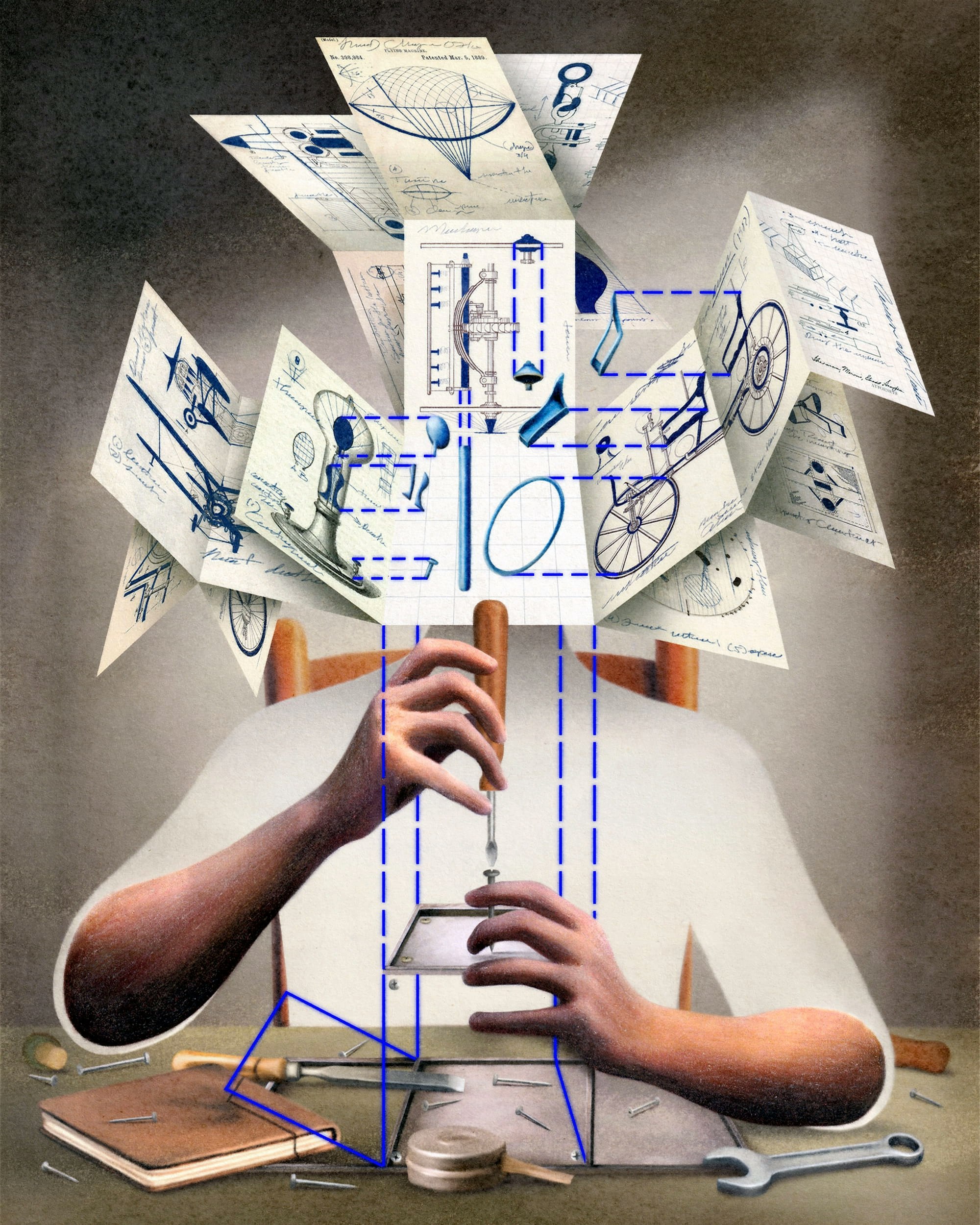
The work of tinkerers often gets left out of the tale of the single, genius inventor, but it’s arguably no less impactful to a given technology’s trajectory. In the U.S., tinkers have come in the form of rural farmers who turned Model T cars into tractors and butter churns, the amateur operators who claimed the early radio spectrum in the early 20th century across the U.S., and phoneline hackers who bent Bell’s network to their will in the 1960s and 1970s. Indeed, tinkerers have shaped the future by testing the mettle and imagination of technologists and provoking corporations to respond with more ingenuity and capital, and we may well be entering a new tinkering era with software and vibe coding.
Churning butter with a Model T
“Car culture” has become synonymous with modern American life. But the opposite has also been true: American society has fundamentally shaped cars, their development, and their use.
From 1910 well into the 1940s, large automakers, such as Ford, defined the early shape of the industry. Ford created separate automobile commodities such as tractors and trucks. But an extra tractor or truck wasn’t always affordable, so many amateurs reinterpreted the car itself, using kits to amend what they saw as flexible, general-purpose tools. Their work was supplemented by a subculture of kit-makers, who saw the car not just as a means of transport, but as a portable source of power that could be put to work in other useful ways.
Most kit-making was concentrated in rural areas. In Reynold Wik’s Steam Power on the American Farm, he notes that farmers often ran and repaired everything on their own. The most popular kits of the time either converted cars into power sources for the home that were used to run washing machines or churn butter, or into tractors for farm work.
Between the early 1910s and late 1920s, Ford was the largest manufacturer of automobiles by some distance. Model Ts were particularly popular in the cheaper segment of automobiles. By 1913, Model Ts made up 96% of all cars sold for less than $600. Rather than buying a full-size tractor, many tinkerers used the Model T to make a cheaper, lightweight tractor, usually with the help of kits from businesses like the Pullford Company. A Model T cost around $400 and the kits were priced anywhere between $90 and $250, whereas a full-size tractor could cost between $950 and $3,000.
A subculture of kit-makers saw the car not just as a means of transport, but as a portable source of power.
These were by no means isolated experiments. It’s estimated that around 300,000 farmers and reporters attended Pullford Company’s demonstration of their tractor attachments in Fremont, Nebraska, in 1917. Eventually, the tractor conversion kits would become mainstream enough to be sold in department stores such as Sears and Montgomery Ward.
The kit-makers had revealed a market. Without manufacturing or selling anything at scale, they demonstrated that ordinary farmers would turn a general-purpose car into a working tractor if the price was low enough.
In early 1917, Ford released the one-ton truck and in 1918, the gasoline-powered tractor, both of which covered much of what kit-makers were already selling. Both of these came out to around $600, which was still more expensive than using conversion kits on a Model T that a farmer already owned. But Ford kept driving down costs. The Fordson tractor dropped to $395 by 1922. By 1923, Ford owned 75% of the tractor market — but just a few years later, it had been beat out by competitors. In 1928, Ford moved U.S. production of its tractors abroad, focusing much of its sales internationally as well.
Ford’s cheap tractor and the ensuing products were, in effect, the kit-makers’ idea turned into a product by someone else. And despite the prevalence of cheap tractors, kit-making persisted. During the Great Depression, the use of cars as general-purpose tech that could be readily supplemented peaked. Tinkerers of all sorts continued to turn to attachments because they were versatile enough to cover multiple single-utility use cases. Many rural families had bought cars during the prosperous years of the Roaring Twenties, but as the economy tanked, they were urged to plow their farms to the fence to maximize production and address food shortage (a misguided practice that would contribute to the devastating effects of the Dust Bowl). Families that could not afford a full tractor used attachments on their cars to accomplish this.
Meanwhile, some smaller companies took advantage of the kit opportunity. Moline advertised its car with a removable back seat option as a “car for farmers.” In the late 1930s, it also built a hybrid tractor-car, which looked like a crossover between a buggy and an excavator.
As Americans emerged from the Great Depression, a plethora of single-utility products emerged.
However, Ford’s decisions still ruled the automotive industry at large. Eventually, it asked dealers to not sell conversion kits altogether. As Americans emerged from the Great Depression, a plethora of single-utility products emerged. Consumers acclimated to the idea of buying a vehicle for transportation, another for getting around the farm, and another for farm work. New Deal loan programs made tractors newly affordable, and manufacturers introduced cheaper, mass-produced tractors with rubber tires and belt-power capability.
Slowly, the amateur kit industry declined. Sociologists Ronald Kline and Trevor Pinch found that the last advertisement for the Pullford Company, the longest-surviving kit-maker, ran on February 10, 1940.
Still, as the farm-based kit culture in rural America died down, kit culture itself lived on in other ways. From the late 1930s into the 1940s, hot-rodding took off across southern California, and eventually spread beyond it. Hot-rodders used the Ford Model T as a base and swapped out its engine for one that was more powerful, continuing the tinkering tradition of influencing the future of the car.
Different frequencies, same outcomes
Amateur tinkerers have even outpaced corporations at figuring out the right use cases for new technologies. As Susan Douglas writes in Inventing American Broadcasting, Italian inventor Guglielmo Marconi invented the radio in the 1890s. At the time, he described it as useful for communicating between institutions and organizations such as newspapers, the navy, and ships.
Several wireless radio companies were set up in the early 1900s to promote the radio as a distinct communication channel for organizations like the ones Marconi had described. A useful comparison might be how Slack or Microsoft Teams have been marketed to us — but, unlike the companies making today’s ubiquitous tools, most of these failed to get widespread adoption. Between 1906 to 1912, many went bankrupt, including a few that were found to be stock-promotion frauds.
Instead of airwaves being pioneered by corporations and militaries, they became the domain of amateurs.
There was one major problem with radio as far as institutional customers were concerned: privacy. Radio could be intruded upon by other operators, and point-to-point signals could be intercepted by eavesdroppers and disrupted by interference from other stations on the air. Both the military and many corporations saw these as serious drawbacks to be solved before adopting the technology.
So, Douglas notes, that instead of airwaves being pioneered by corporations and militaries, they became the domain of amateurs, particularly young men across the U.S. Headlines between 1905 to 1912 contained reports of public telephones going missing because they had been stolen to make amateur radio sets. Douglas uses the example of Walter J. Willenborg, a 26-year-old student from Hoboken, New Jersey, who built his own transmitting and receiving station at home, as the prototypical young inventor-hero the popular press canonized in the early 1900s. In a 1907 New York Times front-page feature (“New Wonders with ‘Wireless’ — And by a Boy!”), Willenborg described listening in on Marconi’s transatlantic traffic between Glace Bay, Nova Scotia, and Clifden, Ireland, and predicted he would soon be exchanging messages with Paris and Berlin from his own set.
The radio era involved amateurs claiming a space that corporations had failed to see a use case for, but this wasn’t all tinkering was limited to. Tinkering was also useful to claim spaces that a corporation had already locked down. In the 1960s, the telephone industry was dominated by Bell System, a company that was seen by many as an embodiment of monopoly capitalism and the military-industrial complex, an entity to be rebelled against.
Bell System engineers used in-band signaling for routing telephone calls, where the same channel that carried your voice could also carry control tones that told the network what to do. A 2600 Hz tone, for instance, would tell the system that a trunk line — which carried traffic between switching centers rather than between individual phones — was free. It enabled nationwide direct dialing, and had been built out between the 1950s and ’60s. In the mid 1960s, a national, informal network of amateur tinkerers grew obsessed with the ins and outs of the telephone network, specifically the 2600 Hz control tones. This group, who called themselves “phreakers,” discovered that they could recreate the 2600 Hz tone using an innovation they referred to as a “Blue Box,” a pocket-sized multi-frequency tone generator that allowed them to call anyone, anywhere, anytime, for free, on AT&T’s tab.
Large companies, of course, were not happy with this. Between 1964 and 1970, AT&T monitored some 33 million toll calls in an attempt to catch phreakers, documenting over 25,000 cases of known illegality. Still, they couldn’t quite catch hold of the phreakers: By the mid-1970s the company was reporting losses between $10 to 20 million a year to phone fraud.
Tens of thousands of Americans, including college students, businesspeople, celebrities, and white-collar criminals were dabbling in phreaking.
It was a hack that took off far beyond the initial group. Through the early and mid-1970s, front-page features in the Wall Street Journal suggested that tens of thousands of Americans, including college students, businesspeople, celebrities, and white-collar criminals were dabbling in phreaking. As Ron Rosenbaum wrote in an October 1971 Esquire feature, “it gives you the power of a super operator.” That is, phreaking gave people the ability to do everything a telephone operator could do, and sometimes more.
And many phreakers weren’t just chasing free calls — they were getting an early taste of connecting with people across the country (and sometimes world) while staying in one place. Phreakers would play around with the network, calling random locations. They even tried conference calling, using the company’s internal maintenance infrastructure like loop-around test circuits and beep lines to talk with multiple strangers at once.
And phreaking created a steady, underground drumbeat, with magazines sharing tricks of the trade, including the activist-run Youth International Party Line, which launched in 1971 and in 1973 evolved into the Technological American Party, then the Technological Assistance Program.
For some phreakers, joining the amateur underground was just the beginning of a relationship with challenging our expectations of technology. Take, for example, Steve Wozniak and Steve Jobs: Before they became members of the Homebrew Club that led to the first Apple computer, they were phreakers selling the blue box door-to-door. In 1971, Wozniak read the Rosenbaum piece in Esquire; the very same day he and Jobs snuck into Stanford’s library to find the technical specs, went out to buy parts, and built a rudimentary blue box prototype. When they were ready to hock their wares, they introduced themselves by what were called phone phreak handles — pseudonyms that provided both coverage and identity. Woz went by “Berkeley Blue,” and Jobs by “Oaf Tobar.”
Wozniak would later describe his time phreaking in 2013’s Exploding the Phone, The Untold Story of the Teenagers and Outlaws Who Hacked Ma Bell as “doing something that nobody would really believe was possible.” And Jobs, in a 2012 interview with Robert Cringely, touted the impact on their joint future: “We were young and what we learnt was that we could build something (blue boxes) ourselves that could control billions of dollars worth of infrastructure in the world… I don’t think there would have ever been an Apple computer had there not been blue boxing.”
These interstitial builds can solve problems long before corporations realize they exist, and influence and change the direction of a technology’s future.
Like many epochs of tinkering, the phreaking era eventually came to an end. In the 1970s, telephone companies started to move to out-of-band signaling, routing calls through a separate control channel inaccessible to anyone on the line itself. It would take years to cover the network, well into the 1980s. Eventually, the rails phreaking was built on were rendered obsolete.
Phreaking may have phased out, but its spirit lived on. As Jobs and Wozniak would later show, many of the same amateur tinkerers who dominated the era would move onto the next technology that was open to interpretation: packet switching, or breaking information down into bite-size pieces to send between computers and the internet.
And while the phreaks left no durable artifacts, they were part of an impulse that’s still alive today, to tinker with the next new technology while it’s still loose enough to interpret. These interstitial builds can solve problems long before corporations realize they exist, subvert dominant uses of technology that aren’t working, and influence and change the direction of a technology’s future.
A similar path faces those using LLMs today when they’re interpreting a general-purpose tool to their own use cases or vibe coding their way through the possible. Jobs, in the era of blue boxes, had a popular slogan for the phreakers: “He’s got the whole world in his hands.”
About the author
Sachin Benny is a writer and technologist. He writes the technology and culture newsletter Summer Lightning and has been a lead researcher at the Protocol Institute since 2025.
Share article
Related reads

Dynamic pricing strategies for your ecommerce business


Ctrl-Z-the-world