The future belongs to those who prepare like Dwarkesh Patel

In a world with over five million podcasts, Dwarkesh Patel stands out as an unexpected trailblazer. At just 23 years old, he has caught the attention of influential figures such as Jeff Bezos, Noah Smith, Nat Friedman, and Tyler Cowen, who have all praised his interviews — the latter describing Patel as “highly rated but still underrated!” Through his podcast, he has created a platform that draws in some of the most influential minds of our time, from tech moguls to AI pioneers.
But of all the noteworthy parts of Patel’s journey to acclaim, one thing stands out among the rest: just how deeply he will go on any given topic.
“If I do an AI interview where I’m interviewing Demis [Hassabis], CEO of DeepMind, I’ll probably have read most of DeepMind’s papers from the last couple of years,” Patel says. “I’ve literally talked to a dozen AI researchers in preparation for that interview — just weeks and weeks of teaching myself about [everything].”
Patel will even try to implement exercises or simulations from the academic papers themselves, sharing how he “implemented a transformer before interviewing Ilya.”
It’s like, ‘Oh my god, I’m just a random college kid. I get to interview this person. So I’m going to spend a week prepping and reading everything that might even be potentially relevant.’
And it would appear the podcaster’s prep-first approach is working. All of Patel’s growth to date has been completely organic. His show has seen guests like a16z founder Marc Andreessen, OpenAI chief scientist Ilya Sutskever, and even the now-convicted Sam Bankman-Fried — a roster that has managed to get the show a loyal following. Patel also writes occasionally on Substack. His most recent piece, “Will scaling work?,” explores the AI takeoff question. It was referenced by Stripe co-founder Patrick Collison and recommended by OpenAI ex-interim CEO Emmett Shear.
At the end of his recent Substack post, he disclaims “[F]or what it’s worth, my day job is as a podcaster.” But the disclaimer is quickly followed up with “[T]he people who could write a better post are prevented from doing so, either by confidentiality or opportunity cost.”
So the world gets AI analysis from people who can show up, do the prep, and speak freely instead. In other words, the world gets it from Patel.
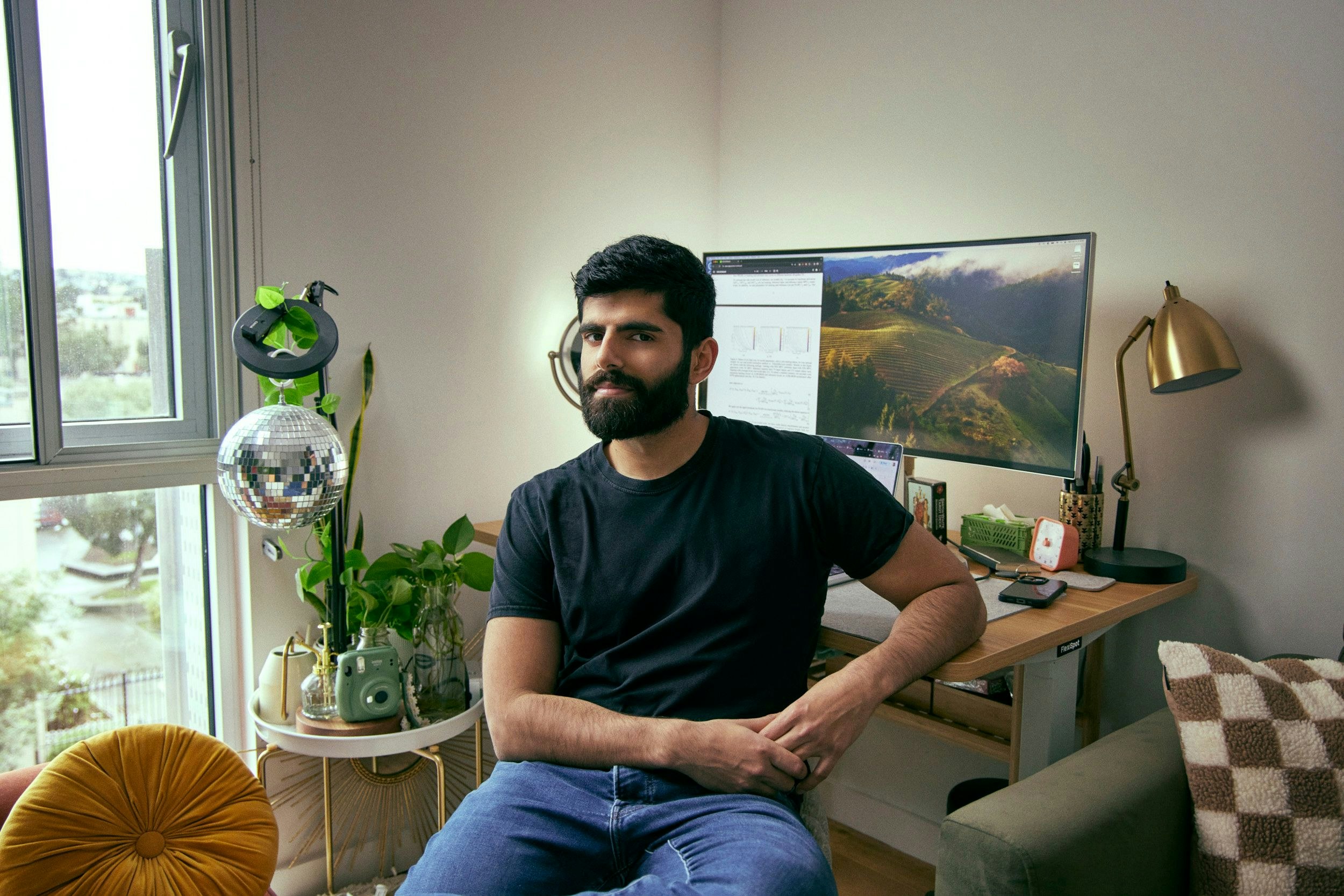
When I speak to him, Patel dials in from his room in a group house in Hayes Valley, San Francisco. He tells me it’s what he can afford through grants like Emergent Ventures. But I know that he’s currently well positioned in the home of the world’s largest concentration of AI startups.
Pro tips for founders from Dwarkesh Patel


Patel only came to America when he was around nine years old, spending his early life in India. His father, a doctor, sought an H1-B visa and was often assigned positions in rural America, where there was demand for quality doctors. Through Patel’s teens, the family shuffled around states like North Dakota, West Virginia, Maryland, and later, Texas, where Patel eventually attended college.
He graduated from UT Austin in December 2021 with a degree in computer science. It’s where he was taught by professors like Scott Aaronson, the well-known computational complexity theorist and author of Quantum Computing Since Democritus. It’s also where he launched the Lunar Society Podcast from his dorm room on a whim during the heights of the COVID-19 pandemic. It was a time when Patel was feeling particularly intellectually isolated and turned to books for inspiration.
He was reading The Case Against Education when he cold-emailed author Bryan Caplan to share that he loved his book. To Patel’s surprise, Caplan replied. It was then that Patel decided to “shoot his shot” and ask Caplan for a podcast episode.

“He assumed I had an actual podcast. I didn’t even have a name for a podcast. But he was kind enough, he did it,” says Patel. Caplan became Patel’s first-ever guest.
To Patel, it was a big deal. “It’s like ‘Oh my god, I’m just a random college kid. I get to interview this person. So I’m going to spend a week prepping and reading everything that might even be potentially relevant.’”
Fortunately, the prep paid off. “Caplan enjoyed the podcast so much that he recommended it to Tyler Cowen of GMU. Cowen came on pretty early. From there, it just became something I did on the side while in college.”
This level of deep research is, for Patel, a way of respecting the opportunities he has in being able to speak to highly-regarded figures with influence, despite starting from a place of little influence himself.
Today, Patel is quickly becoming known as “the new Lex Fridman” and even “Lex Fridman but better.” Here, again, he credits his success to prep. On Fridman and other competitors, Patel says, “Sometimes it doesn’t feel like they’re trying. In other fields, if something is your full-time job, there’s an expectation for you to spend a lot of effort on it. The idea of popular podcasters just walking into a studio after just a single day of prep… It’s like, this is your full-time job, man. Why don’t you spend a week or two instead?
Keep the insights coming.
Get relevant reads and resources in your inbox, once a month.
“Most of the prep I do just doesn’t end up being useful because I’ll have read a random thing that never came up in the conversation,” he says. “But some of the things I end up reading, even randomly on my own time, lead to interesting conversations.”
There is a growing cult following of Patel fans who appreciate this approach. Guests on his podcast might be the same guests that Lex Fridman talks to — guests from a wide range of fields who might also have important insights on technology. But Patel is going to stick only to that guest’s domain, attempting to, in his own words, “80/20 an undergrad course on the topic” before the interview. In this way, the 23-year-old has managed to create his own seat, at his own table, for some of the most important conversations about AI, economy, technology, and history.
The Pareto principle, also known as the 80/20 rule, states that 80% of the consequences come from 20% of the causes. (It stems from the Pareto distribution, a power-law probability distribution that describes phenomena across a variety of fields.) When applying the Pareto principle to the broader podcasting industry, where a few podcasts achieve significant success over the more than 5 million that exist today according to Forbes, it suggests that a small percentage of podcasts (around 20%) garner a large majority (approximately 80%) of listenership, engagement, and revenue.
This information might discourage most aspiring podcasters from even trying, but it did not discourage Patel. The recent conversation he had with Patrick Collison is top-of-mind for Patel as he shares how the idea of an industry being too crowded, in the first place, is somewhat of a fallacy.
“This is something I was thinking about when I was interviewing Patrick. In some sense, when he started Stripe, payments was a super crowded industry. There’s PayPal, there’s obviously Visa, Mastercard. But, in another sense, there’s something strange in terms of domains you think of as crowded and totally competitive. There are usually totally obvious blind spots.
“In my case, it was just that I decided that I was going to spend a week preparing for a podcast episode instead of just a day. That doesn’t seem like it should have been the case. Similarly with Stripe, it was just ‘We’re going to make it easier for somebody to build an API for payments.’ It doesn’t seem like it should have been something PayPal missed. But in a strange sense, a lot of seemingly competitive domains are pretty easy to get a handle on.”
There’s another key insight Patel shared from his talk with Collison. I ask him about his strategy in leading podcast episodes, specifically if he ever feels torn between a breadth-first and a depth-first approach — concepts borrowed from the two search algorithms that nearly every CS student learns at some point. How exactly does he grapple with the decision to either explore a wide range of topics superficially (breadth) or delve deeply into a few specific areas (depth)? Breadth has the advantage of appealing to a more general audience; for depth, it’s honoring the domain expertise of his guests.
On this, he goes back to Stripe and says “When you have an API that’s also responsible for payments, you need to make sure that it’s super reliable and secure. But you also need to be fascinating to other startups, which means you need to be deploying often. Stripe figured out how to do thousands of deploys a day on their API but also run an extremely reliable set of internal tests to make sure that they’re all secure.
“In my case, people often say ‘Oh you can’t do as many episodes if you want to go deep.’ But you have to realize, at some point, that the Pareto Frontier is so far out there that you can just optimize for everything.”
A “Pareto Frontier” describes an optimal state in decision-making processes where you can’t improve one aspect without compromising another. Imagine a scenario where you’re trying to balance two competing objectives, like quality and cost. The Pareto Frontier represents the set of all points where you achieve the best possible balance between these objectives. It’s finding the sweet spot where you get the most quality for the least cost — and any move away from this point means you’ll either sacrifice quality or increase cost.
In the context of podcasting, as Patel refers to it, the Pareto Frontier would be the ideal balance between the number of episodes (breadth) and the depth of each episode. It’s about finding that point where you can produce a high quantity of episodes without sacrificing the in-depth exploration of each topic.
Except, as he has realized, in most cases, and especially his, “you are so far from the Pareto Frontier where you have to make that trade-off.”
The loyal listenership, the accolades from tech’s best leaders, the Substack response articles — it’s all impressive. But what Patel feels most proud of has little to do with it. “There’s the big interviews and those go viral, everybody hears about them,” he says. “But there are a few scholars who were not that well-known before I interviewed them. Sarah Paine is someone I interviewed recently, a historian and professor at the Naval War College. After she did the interview, her boss — the college president — was like, ‘Oh my god, this is the biggest media thing that has happened to the Naval War College.’ I’m sure she got a bunch of cold emails after. Noah Smith even interviewed her because he liked that interview.”
It’s a sign of the increasing credibility and influence of Patel’s work. (His episode with Anthropic CEO Dario Amodei even happens to be part of the congressional record.)
Everything that is relevant to understanding society is relevant to understanding AI.
While the podcast has grown to indisputable impact, there have been a couple of fans who were slower to recognize the credibility of Patel’s work: his parents. “They thought it was a total distraction. You know what’s funny? When Jeff Bezos said on Twitter, ‘You’re thoughtful and thought-provoking, please keep going,’ something like that, my parents were like, ‘Oh, that’s cool. You think you can talk to him about getting a job at Amazon?’”
Fortunately, after Patel’s interview with OpenAI chief Scientist Ilya Sutskever, which has over a half million views on YouTube, his parents came around to supporting his work.
AI holds most of Patel’s focus and curiosity these days, serving as a thematic center that informs all his episodes — even those that draw heavily from other disciplines, like history or economics.
“I think it has the potential to be the most important thing ever. There are so many different domains you have to understand to think about it because, in a sense, it’s like [creating] a new society. So everything that is relevant to understanding society is relevant to understanding AI.”
Though Patel has neither a PhD in machine learning nor a position in tech policy, he isn’t afraid of the undertaking. “This is a common thing I’ve seen among high-agency young people,” he says. “They get to meet the people who are supposed to be in charge, early on in their lives, and realize, ‘Oh they’re just regular people. They seem competent but it doesn’t seem self-evident that they’ve got it handled.’ And sometimes it’s not fully handled.
“I’ve interviewed people where it seems like they haven’t necessarily thought about something as much as I would’ve hoped. Or I’ve gotten to a point where I’ve thought about a specific subtopic more than they have. That’s when you realize that you’re a part of the clique that’s supposed to do the thinking about it.”
If Patel is right about AI changing society the way that he imagines — about how much it matters — then his podcast has the potential to matter just as much. It’s being listened to by at least some of the right people in power.
Despite this information — or even pressure — he approaches his episodes in a more personal way. He refers to a quote by computer scientist Donald Knuth: “A program is written by an individual to be read by another human being, and it’s only incidentally true that computers can execute it.” He notes that “similarly, with podcasts, it’s really meant for me to learn from the person — both through all the preparation and the conversation — and only incidentally for the audience.”
When I ask him what he imagines his work might look like, in the future, in the new society he believes AI will create, he smiles.
“One of my friends put it this way, who’s an AI researcher himself. He said, ‘You were lucky enough to have the job that you would have in the post-singularity world anyways.’”
Read more Meridian stories.

Illustrator María Jesús Contreras on the value of authentic work

Fishwife founder Becca Millstein on brand as leverage

A new age for an anti-slop internet