Monitoring your finances isn’t the same as understanding them

Gerhard tells customer stories at Mercury.
It’s 11 PM on a Sunday and you’re staring at a spreadsheet, trying to answer a question that was supposed to take fifteen minutes. You’ve got three tabs open: bank account, a CSV export from last month, and a sheet in which you’ve been manually tracking burn since the business was two people and a doc. The numbers don’t quite add up. They never quite add up.
You’re not trying to perform financial analysis. You’re trying to answer a question — one specific question that’s been sitting in the back of your head since Tuesday: Can we actually afford to add headcount this quarter?
This is the version of financial management folk don’t always talk about. Not the polished dashboards in pitch decks or the CFO-grade models that live in Series C board rooms. It’s the pondering that happens at kitchen tables and in the Notes app, trying to find a story and solution through the numbers whether the money makes sense.
The questions that actually keep founders up
Ask a founder what financial questions they’re wrestling with and they won’t say “What’s our EBITDA margin?” They’ll say something closer to:
- Why was last month so much more expensive than the month before?
- How long can we keep going at this rate?
- Where is all the money actually going?
- If revenue stays flat for two more months, are we in trouble?
Ann Stewart Zachwieja, COO of AI startup Intuist, boils it down to a single question she comes back to every time she opens her accounts: “Are we okay, or is this an ‘oh shit’ moment?”
These aren’t accounting questions. They’re decision questions, the kinds that determine whether you hire, invest in a new channel, or renegotiate a contract. And the frustrating part isn’t that the answers don’t exist. It’s that getting to them requires a kind of archaeological dig through tools that were never designed to talk to each other.
Bank statements show transactions, but not trends. Accounting software is optimized for month-end close, not for the Tuesday afternoon when a vendor invoice looks suspiciously high. The information is there, technically, it’s just scattered across enough surfaces that reconstructing it feels like a research project.
Now multiply that across several businesses. Ryan Cunningham runs multiple companies — a strategy group, a payments business, and a personal holdings company — each with its own accounts, vendors, and cash flows. The questions aren’t just about what’s happening inside a single entity. They’re about how money moves between them: whether outside vendor spend in one company is tracking ahead of another, and whether the whole structure is healthy or just parts of it. When you segment risk across a layered entity structure, as Cunningham does, you need to see the full picture without opening four tabs and comparing them side by side.
The spreadsheet, the gut, and the 11 PM text to your accountant
There’s a pattern to how most founders try to close this gap, and it usually involves some combination of three things: a spreadsheet built in the early days that’s since grown into something no one else can maintain, a gut instinct born from checking the bank balance every morning, and an accountant or bookkeeper for when something looks off.
None of them are wrong — they’re just incomplete in ways that compound over time.
The spreadsheet approach works until it doesn’t. It’s fine when you have twelve transactions a month and one bank account. But companies grow… and spreadsheets do, too — more tabs, more formulas, more places where a broken reference throws your burn calculation. And here’s the part that doesn’t get discussed enough: By the time you’ve finished updating the thing, the data is already stale. You’re making decisions based on a snapshot that expired while you were formatting cells.
David Jimenez, the founder of Drillby, puts it simply: “When we look at the transaction list, we might just go through it and think, what’s paid is paid. But we don’t exactly know how much everything costs over time, or how much I’m spending in specific categories.” He’s describing what most founders experience but rarely articulate — the difference between seeing your transactions and actually understanding what they mean.
Gut feel is more useful than people give it credit for. Through experience we develop a genuine sense for when something’s off — a month that felt expensive, a category that seems to be creeping upward. But a sense isn’t a number. And when you’re deciding whether to make a hire or double down on a marketing channel, that sense won’t survive scrutiny. It also shouldn’t have to.
The accountant call is the backstop, and it’s a good one. But accountants work in historical time. They’re reconciling last month while you’re trying to decide about next month. The cadence is off. Not because anyone’s doing their job wrong, but because the tools are oriented toward compliance, not the forward-looking clarity that operational decisions need.
What this actually costs
The obvious cost is hours. Exporting CSVs, cross-referencing data across tools, and manually categorizing transactions. The spreadsheet becomes the job instead of the tool for doing the job.
But there’s a subtler cost here: confidence. When every financial answer requires an hour of assembly, you start to second-guess whether the answer is even right. Was that burn number calculated the same way as last month’s? Did you exclude internal transfers? Did you accidentally count that refund twice?
The process introduces so much friction that teams either over-rely on stale data or stop looking at the data entirely. Both of these outcomes lead to worse decisions made with less information than was actually available.
Then there’s the cost of what you never catch at all. Jimenez discovered that a vendor had quietly raised its recurring monthly charge — likely because an introductory discount expired. “In the transaction list, you don’t really see it because each month you don’t check everything,” he says.
Zachwieja at Intuist tells a version of the same story from the other side of the equation. Her largest expense category is software. Subscriptions, API charges, and infrastructure costs that shift as the product evolves. “It’s easy to lose sight of these things,” she says. “Tracking the running costs of our entire tech stack is very useful, especially as we scale.” Before she had a structured view, she’d open the Transactions page, filter by keywords, and scan for patterns. It gave her a general sense, but general isn’t good enough when revenue is X and fixed costs are Y and you need to know exactly what Z looks like.
Cunningham describes a version of the same trap at a different scale. Running payments through a platform like Venmo — fast, frictionless, easy — he didn’t register how quickly those transactions were adding up until the aggregate number confronted him. He calls them “ease of access” platforms: tools so convenient that they bypass the mental accounting you’d normally apply to a wire transfer or an invoice. The cost isn’t the individual transaction. It’s the accumulation you never paused to tally.
These costs aren’t abstract. They show up in the quality of every decision that touches money.
When the answers are already there
Imagine the same Sunday night from earlier. This time you open your bank account and the answer is sitting there: a clear view of your burn over the last three months, your runway calculated from your actual balance, your spend broken down by category with the largest changes flagged. No exporting. No formulas. No cross-referencing against three other tabs.
The question about headcount might still be complicated — hiring decisions always are — but at least the financial input is clear and current. Not something you reconstructed from memory and a CSV at 11 PM.
That vendor invoice that looked suspiciously high? Instead of scrolling through transaction history trying to remember what it was last quarter, the change is already flagged. Jimenez experienced this firsthand: “Insights told me, ‘This recipient charged you more than before.’ And then you can make a decision based on this.” The data moves with your questions rather than requiring you to rebuild the analysis every time you have a new one.
And when something genuinely anomalous happens it’s not buried in a row on a spreadsheet you might not open until the weekend. You find out when it happens, not when you remember to check.
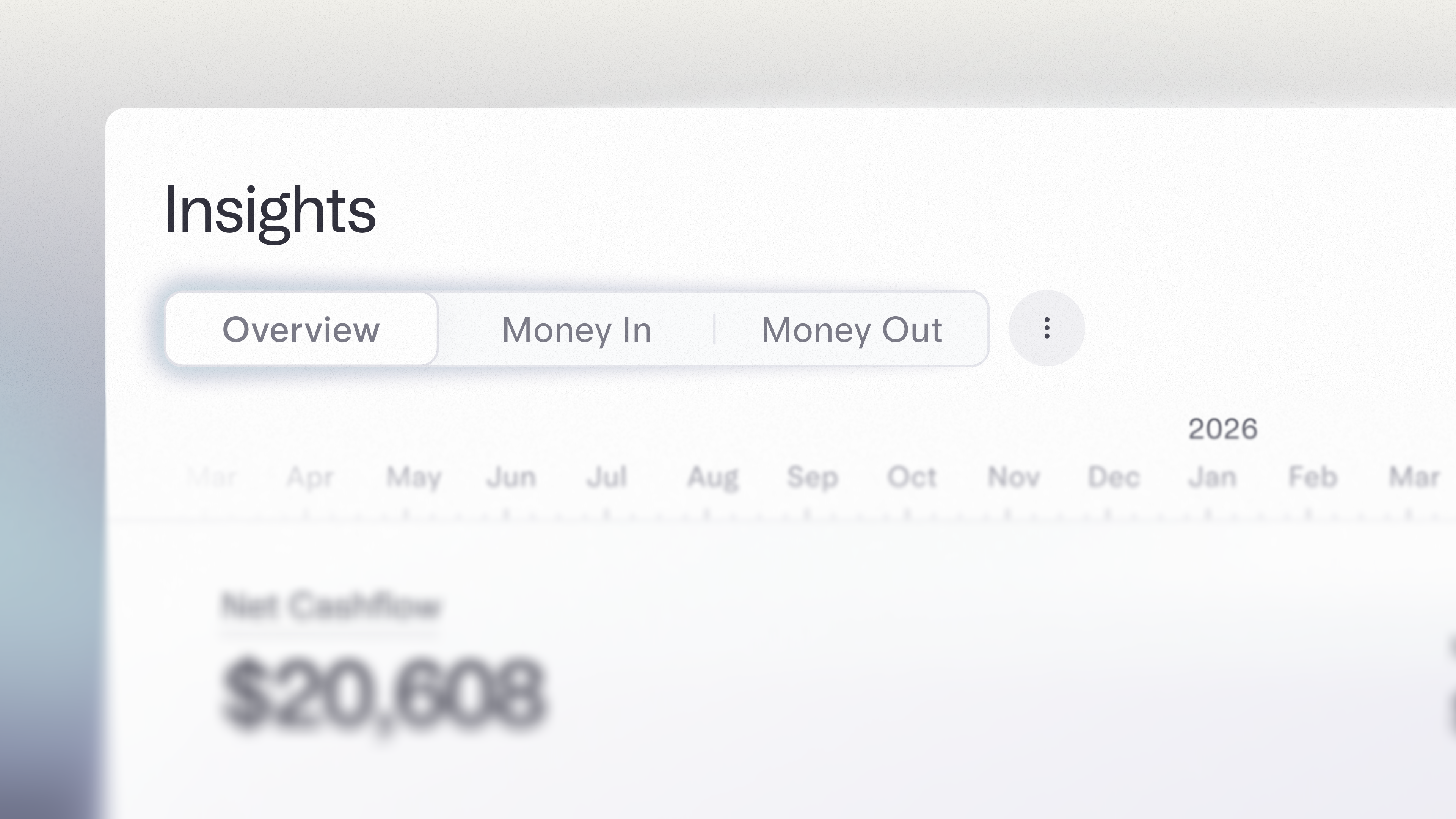
This is why Insights exists. It takes the financial data already in your account — every deposit, every payment, every transfer — and organizes it into answers. Transactions are automatically categorized. Trends are visualized in real time. A financial recap surfaces the most relevant cashflow changes so you’re not hunting for what matters.
For Zachwieja, it replaced a manual keyword-filtering routine with a structured weekly review. She visits the Insights page a couple of times a week now — checking burn, runway, and top spending categories in one glance. “We pay particular attention to Insights when our monthly recurring payments come in,” she says, “to make sure we’re getting paid but also to gauge how we’re tracking to larger recurring revenue goals.”
For Jimenez, it turned idle curiosity into a cost-cutting habit. What started as browsing a new page in his Mercury account led him to identify and cancel an unnecessary subscription before it compounded into months of wasted spend.
For Cunningham, the shift was more immediate. He checks Insights at least once a day — first thing in the morning, before anything else. “It’s a good way to start my day,” he says, “to see where I’m at, the health of the business, the overall trajectory.” He toggles between his entities in a single dashboard, tracking how money flows between them and where outside spend is landing, without having to open QuickBooks or run a separate report. What used to require side-by-side comparisons across platforms now lives in one view.
From monitoring to understanding
There’s a meaningful difference between monitoring your money and understanding it, and it’s worth being precise about this. Monitoring is a habit, not a strategy. Understanding is knowing, without effort, that your software spend increased 15% this month and that most of the increase came from a single vendor.
Is this normal? Is this a trend? Should I do something about it? Those are the questions that sit in the gap between raw data and good decisions, and they’re the ones that have historically required either expensive tools, dedicated hires, or a lot of manual work.
Cunningham puts it differently. For him, the dashboard doesn’t just answer questions — it generates them. “It prompts my questions throughout the morning,” he says. Seeing where money is allocated leads directly to decisions about where it should be reallocated: which categories can absorb more spend, which ones need to be pulled back, how all of it aligns with quarterly goals. The data doesn’t sit passively waiting to be interrogated. It informs the day’s priorities.
Jimenez is candid about this: “I have enough visibility to know what to do. I think the priority will be more like a salesperson. I have enough tools to handle the finance side myself right now.” When your bank account provides that kind of clarity, it changes the hiring calculus. Not because the finance function doesn’t matter, but because the founder can stay close to it without it consuming their week.
The finance relationship changes from obligation to information.
The question behind the question
Every financial question a founder asks is really about something else. “How long is our runway?” is really “Are we going to be okay?” “Why was last month so expensive?” is really “What did we miss?”
The distance between asking these questions and getting a clear answer shouldn’t be a spreadsheet, a CSV export, and three hours on a Sunday night.
About the author
A beat journalist at heart, Gerhard “G” Jacobs is a customer storyteller and advocate based in the San Francisco Bay Area. When not telling customer stories, G dedicates his time to his rescue dog and cat.
Share article
Related reads