A catalog of possibilities
Jaya Saxena is a New York-based writer focused on food, culture, and labor.
Yidi Campbell knows how to sell you what to wear. She co-founded the accessories company Terracotta New York before moving on to strategy and corporate development for brands like Athleta and Gap. But she grew disillusioned with the business of fashion. “It felt like everything was about selling you the next pair of pants, even though it’s probably the same pair of pants that you already own,” she says.
Campbell was caught up in the cycle, too — shopping on Instagram with one click while last month’s purchases languished in the back of the closet. “I felt like I was really losing control,” she says, adding, “I had all these things, but it still felt confusing getting dressed in the morning.”
She realized other people probably shared her frustrations and were looking for a way to sort through the madness of their closets. Her solution was founding Indyx in July 2021. Indyx is a closet cataloging app that helps its users hone their style with what they already own. In Indyx’s case, the app’s design allows you to channel your inner Cher Horowitz by uploading photos of your clothes and accessories into an organizable digital wardrobe, then mix and match them into outfits. It can automatically pull every item of clothing you’ve bought in the past three years from your email account, or pull from online retailer photos, so you don’t have to meticulously photograph each item. The act of seeing what you own clearly, says Campbell, doesn’t just give users another way to organize all their shirts. “The suite of tools that we’ve built is essentially a way for you to start breaking style down as a learnable skill.”
There’s a distinction between collectors who collect and collectors who use.
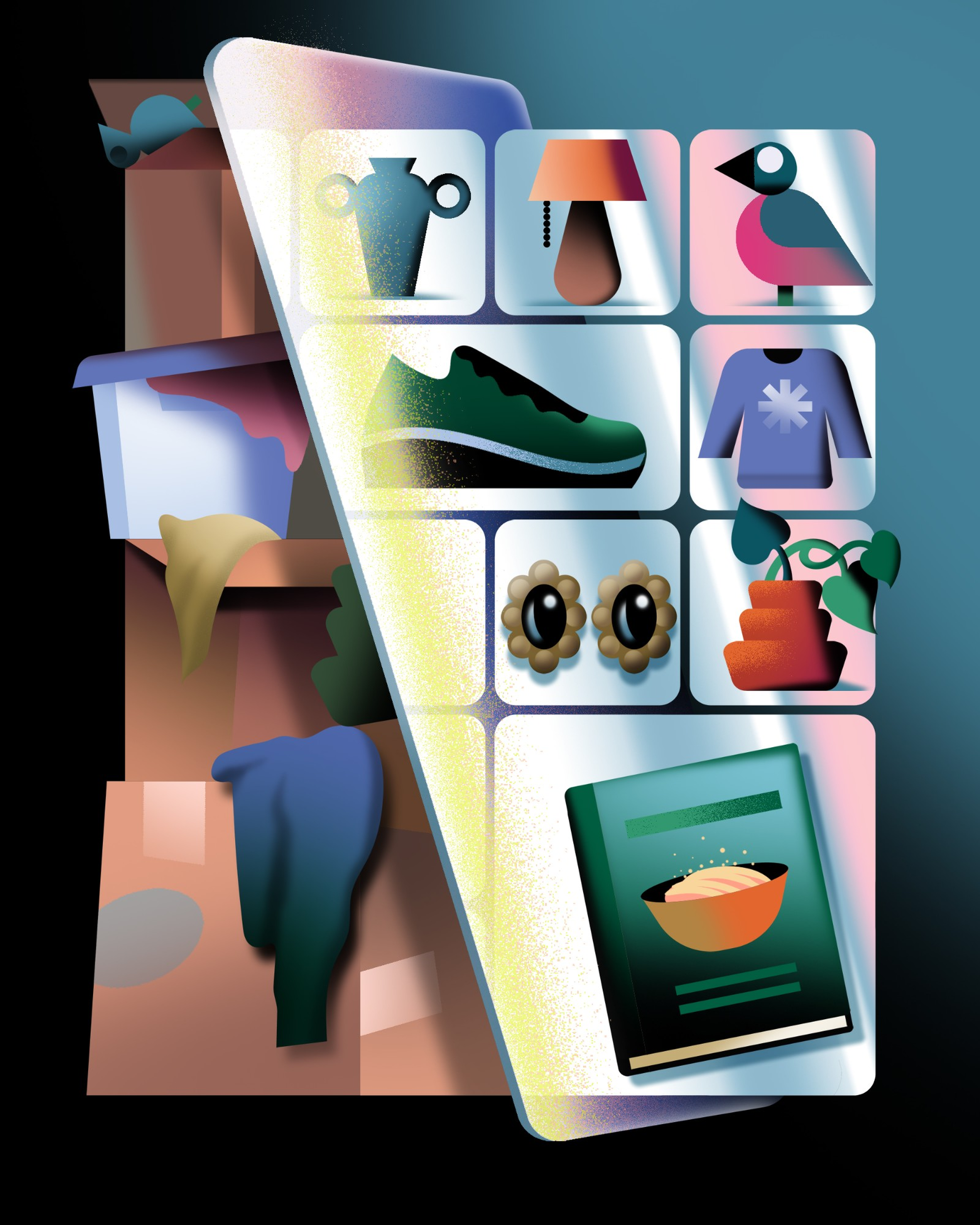
It’s the eternal problem of our modern era — consumers have too much stuff, and yet often feel we don’t have the right stuff. Indyx is one of a number of apps that seek to counteract the endless enticements of consumer culture and help people realize that, more often than not, the feeling of newness they seek can be created with what they already have. For (almost) any type of collection, there’s an app to capture it. There’s Brickit, which catalogs LEGOs and offers new ideas for what to build with them. There are apps to keep track of your makeup, kitchen pantry, and your collections of Pokémon or Yu-Gi-Oh! cards.
But the best of these apps do more than create an enormous list — they will bring a collection alive. “There’s a distinction between collectors who collect and collectors who use,” says Katie Thacher, CEO of online cookbook catalog CookShelf. Many people collect kitchen utensils, sneakers, or nail polish because they love being surrounded by objects suffused with possibility, but then find themselves not knowing how best to utilize these things once they have them — or become overwhelmed by the size of the collection and lose sight of what they have.
Thacher discovered the world of online cookbook cataloging via Eat Your Books, a website founded in 2009 by Jane Kelly and Fiona Nugent as a way for users to search cookbooks for keywords like specific ingredients or recipe times. “I was really enjoying how [Eat Your Books] made it so much easier to find things that I otherwise wouldn’t have,” Thacher says, noting how she started using cookbooks she hadn’t picked up as often. She found it especially helpful when trying to plan grocery lists while she was at work or otherwise not in front of her cookbook collection.
At the time, Thacher was working as a principal product manager at Amazon. When she left in 2023, she thought about what would make her excited to work again, and realized how much she was using Eat Your Books. “I wished I could make the site do more, and be more fun,” she says.
Read more about founders whose products reshape users’ everyday lives:


She reached out to Kelly and Nugent to see if she could get involved. Instead, they asked if she wanted to take over: They were getting ready to retire. “They wanted to make sure that the business went to somebody who cared about the core product and helping people use their cookbooks more,” Thacher says, “and wasn’t just going to buy it for a data set and shut it down.”
Part of Thacher’s vision was to make Eat Your Books usable as an app. Rebranded as CookShelf, the website and app has users scan the barcodes on their cookbooks, which allows them to view indexed, searchable information in the books like recipe titles, ingredients, and cooking times. It also hosts a community of paying users who swap tips on what they like in the same books or on what books you may want to add to your collection.
A print cookbook’s index is inherently constrained. There’s simply more room in a digital environment to list every detail. That means even if the physical book’s index can’t list every recipe that needs smoked paprika, you can easily see every recipe in your entire cookbook collection that calls for the spice. The digital environment creates space to organize (and then search) collected information in a new way.
The most interesting aspect of these apps might be what they can’t do. CookShelf can’t replace those cookbooks because it doesn’t hold the recipes themselves. Indyx cannot wear your clothes for you. They force you to return to your physical collection and see it anew.
The apps force you to return to your physical collection and see it anew.
CookShelf might shine brightest when indexing a sprawling collection, but other types of catalogs can help squeeze the most verve out of a small one. When Jess Atkins founded Stylebook, a closet visualizing and styling app, in 2009, she needed to max out a limited wardrobe for her job at Lucky magazine as an art assistant. “I needed to look like a person who worked at a magazine” in order to thrive at work, she says.
“It was really just a fun project for me and Bill [Atkins, her co-founder and now-husband],” she says. When the idea for Stylebook emerged, the two were dating and early in their careers. The initial inspiration came from her previous internship working in the fashion closet at Vogue, where clothing was cataloged in thousands of Polaroid-stuffed binders. “But then as time went on, I was like, ‘Well, how many people really need that?’” Most people didn’t have Vogue-levels of clothing, but closets much more like her own.
For a one-time download fee, Stylebook allows users to upload photographs of all their clothing and accessories, from which they can explore their closets in a few different ways. It can function as an external memory of sorts: If you want to wear a shirt, you can search back to any outfits you’ve saved to see what you’ve paired it with before, or use a calendar to track what you’ve worn and ensure you don’t repeat looks during a given time period. It can keep you organized by creating outfit collages and packing lists for specific trips, or shake up your thinking by creating outfit ideas for you, with a “shuffle” feature that mixes and matches the clothes you’ve cataloged into new combinations. In 2025 Stylebook introduced new features, such as importing clothing items from your phone’s existing photo library and auto-syncing between the iPhone and iPad.
In a society suffering from digital fatigue, apps that bring users back to their physical lives, and away from their phones, have become essential in a new way. Stylebook is 15 years old, but its emphasis on frugality without sacrificing style has taken off as a counterpoint to today’s fast-fashion overload. “Countless people have written to us to say they actually shop a lot less,” says Atkins, because they’re able to create more with what they already have. Users are also equipped to shop smarter: “They’re more satisfied with the things that they add to their closet,” she says.
Keep in touch
Subscribe to our community newsletter for monthly stories, resources, and inspiration from Meridian and across Mercury.
And these apps still deliver on the half-forgotten promises of the smartphone revolution: that the computers in our pockets would help us overcome challenges, not become a new source of them. Atkins notes how she’s heard from people who are colorblind, who say the app helps them plan outfits by allowing them to mark colors, or from people with mobility issues who have an easier time planning outfits when they don’t have to be standing in front of the closet for long periods of time. But most surprising, she says, are the notes from people who have shopping addictions who say the act of scanning an app that happens to be filled with their own belongings helps scratch the itch. “They’re browsing it in the same way that they would browse Zara, and then looking to see if they had anything that they could use,” she says.
In general, cataloging apps take advantage of the way digital technology can expand time and space to redefine your relationship with your own belongings. Campbell says most people tend to interact with their clothes in the five minutes when they’re trying to get dressed, leaving little room for deeper thought or planning. Now, she says she often finds herself dreaming up outfits and logging them in the app while sitting on the couch.
Because the knowledge of how best to use one’s things isn’t inherent. Knowing how to meal plan, knowing what clothes look good together, those are skills one must learn. Just as studies show writing down notes helps you retain information, taking the moment to mark a completed recipe or to save an outfit you liked helps you build that skill. And while you might use an app to do it, the goal is to engage, not zone out. “We are so used to our phones, so I think this is a fun sneaky way to say ‘You have to go to the book,’” Thacher says. “Which they presumably bought because they love [books].”
About the author
Jaya Saxena is a New York-based food and culture writer. She is a co-founder of Ravenous, and the series editor of the Best American Food and Travel Writing anthology.
Share article
Related reads