The limitations of the ‘internet of things’
Poornima Apte is an engineer turned award-winning freelance technology writer.
When my husband was a graduate student at Pittsburgh’s Carnegie Mellon University in the late ’80s, he could check on the status of a campus Coke machine without leaving his desk. A few years earlier, students installed micro-switch sensors inside the machine and connected them to the internet — which could be checked from any lab desktop — to check whether the machine was well-stocked. The promise of the CMU Coke machine sensor was that those who wanted a cold drink didn’t have to traipse all the way there only to discover it was empty.
The Carnegie Mellon Coke vending machine was the first documented use of the Internet of Things (IoT), or objects built to be connected to a network or the internet. The students’ device has been discontinued, but the ecosystem of “smart” things has exploded, currently extending to household appliances, garage door openers, and home security systems. In 2025, 23% of U.S. households with internet access owned at least one smart appliance, according to research by Parks Associates, and that year, the global market for connected appliances (including those that get online via Bluetooth) was estimated at $42 billion.
Adoptability is about whether people come back after the first use. Do they trust it?
Smart devices haven’t marched into our lives alone. They’ve entered alongside their apps. The app for the GE SmartHQ dishwasher alerts users when the wash cycle is done, and allows them to unlock custom wash cycles and check rinse aid levels. Apps for fancy espresso machines like the De’Longhi Dinamica Plus Connected can customize drinks, save user preferences, and issue maintenance alerts. With the app for the Roomba, the autonomous cleaning robot, users can map rooms, set no-go zones, select and schedule rooms to clean, and monitor cleaning. Throne, a device that clips onto the rim of a toilet bowl, delivers information about its user’s hydration, digestion, and gut health — through an app.
These apps provide utility. But they’ve also come with new complexity. As the ecosystem keeps expanding, consumers seem to be tiring of downloading yet another app simply to use their new appliances. A 2026 report from Clutch, a marketplace for B2B service providers, reported that 80% of smartphone users have downloaded apps because they were required to, not because they wanted to, and 72% felt at least mildly annoyed by the experience.
“Adoptability is about whether people come back after the first use,” says Matthias Woggon, co-founder and CEO at Eyefactive GmbH, which creates software for touchscreen devices. “Do they trust it? Does it fit naturally into daily behavior? Does it remove effort or does it create another thing to manage? That’s the standard I would use.”
In order to build an ambitious and genuinely user-first future for connected and smart devices, we’ll need to revisit the app’s history and rethink our approach.
Read more about founders building better consumer apps

The rise of the smart appliance
“Smart” doesn’t necessarily have the same meaning across all devices. “When people call an appliance ‘smart,’ it’s usually connected to the internet in some way and has additional compute beyond its basic functionality,” says Swarun Kumar, a professor at Carnegie Mellon’s electrical and computer engineering department.
For example, a traditional dryer has sensors and circuitry for a variety of functions, including gauging how warm the clothes are and when to stop the machine. But a smart version of that same dryer might include all of the above and a slightly more powerful microcontroller that connects to the internet. That connection allows you, among other things, to remotely start or stop your dryer, receive cycle-completion notifications, and perhaps track electricity consumption.
The modern concept of a connected appliance has been around in some form — and on a mainstream scale — since at least 2000, when LG introduced an internet-connected refrigerator complete with a TV, MP3 playing capabilities, and a scanner that could reveal fridge inventory. In the following years, Samsung and Siemens would launch their own internet-connected fridges; in 2003, LG innovated with an internet washing machine. By 2005, the International Telecommunication Union announced a new era in which the internet would “acquire a new dimension to become an Internet of Things.”
Remote control is the one thing everybody builds and almost nobody uses.
IoT took a while to gain traction since that 2005 announcement, and the technology really reached peak hype around 2014 when a few other innovations accelerated its implementation. By the mid-2010s, home broadband became commonplace enough that appliance manufacturers could rely on their users’ always-on internet connection. Wi-Fi enabled remote connection from an appliance’s location, eliminating the need for ethernet cables to move information between devices. Cloud computing also increasingly enabled hardware, which made it so appliances could offload the heavy lift away from small devices by routing data through the internet to the cloud for processing. But perhaps the most critical — and obvious — development was the rise of smartphones in the early 2010s.
The smartphone reconfigured hardware. For a long while, we operated machines mostly using the controls built into devices and panels — knobs, switches, dials, and buttons — like the keys on a keyboard or button of a camera shutter. Smartphones pushed these human-machine interfaces (HMI) into digital touchscreens, scaling down transistors, sensors, processors, and wireless components into compact versions that could fit in someone’s hand. Thanks to the rabid demand for smartphones, those parts became cheaper — costs dropped nearly 66% from 2004 to 2018 — and thus more ubiquitous, integrated into more kinds of devices.
But most importantly, the smartphone created a readily available nexus of software and hardware. A device’s internet connection sends real-time information to the cloud; apps and programs on the phone provide an easy interface for users to visualize and act on their data, whether that’s an email inbox or message ping. For appliance manufacturers, the smartphone’s ability to host multiple apps meant the interface for a given device could move away from a fragmented or distributed model — each appliance having its own buttons or remotes — to the phone, where a host of apps and controls could live.
Keep in touch
Subscribe to our community newsletter for monthly stories, resources, and inspiration from Meridian and across Mercury.
The growing utility of an appliance app
An app’s novelty eventually wears off, and the utility of it activating a device from afar is not enough. “Remote control is the one thing everybody builds and almost nobody uses,” says Srinivasa Chaithanya, founder and editor of Hyderabad, India-based VSCTimes. “Starting a washing machine from the sofa is not worth an install, because you have to walk over and load the wash anyway.”
This is where the idea of configuration comes in: Make the app more useful by having it remember your favorite settings so you don’t have to work the knobs every time. “Configuration is the job an app is genuinely good at, because a dial cannot remember,” Chaithanya says.
Having a customer use an app helps companies paint a more accurate picture of their customer base.
Most current IoT apps have three jobs: The first two are to offer remote control and configuration abilities. The last one involves telemetry, or the automated collection of data from disconnected devices. “The machine streams every event to the manufacturer’s servers, and the sensors measure things the owner cannot observe,” Chaithanya says. He uses the example of a water purifier that can measure the current draw on the pump to tell how long a purification cycle takes and whether a filter is choking. Having the data helps manufacturers figure out which parts to fix when things are going wrong, and can allow them to send push notifications, personalize app experiences, and improve customer service.
“Having a customer use an app helps companies paint a more accurate picture of their customer base,” says Pavel Skamartsou, head of mobile development at Innowise, a software development company. In essence, these apps might ultimately benefit manufacturers more than consumers. Appliance makers can use data streamed from apps to diagnose and fix problems proactively, thereby gaining some goodwill. They could also upsell add-ons after analyzing customer user patterns. They may also share data with third parties, like advertising or marketing partners, who might have a vested interest in learning that you’ve just acquired a new high-def TV. Without the data that apps accrue — and the maker’s ability to use it — it’s not clear that IoT would have seen such an explosive push.
Will the app go the way of the dodo?
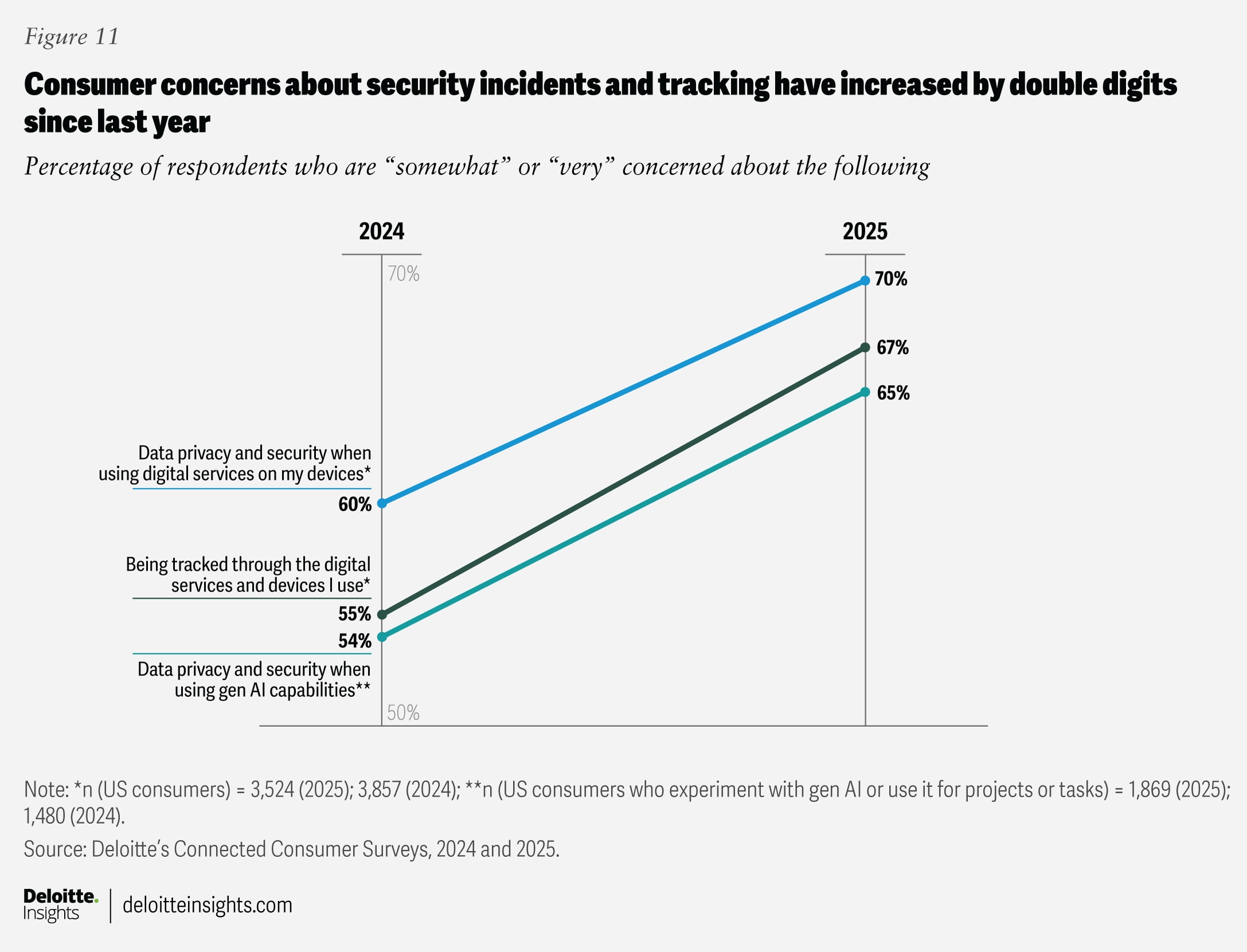
Despite the benefits that apps have brought, like ease-of-use (and an increased sense of control) for consumers and data for brands, not everyone believes they are here to stay. Consumers are increasingly growing wary about data privacy; a 2025 Deloitte survey found that 70% of respondents said they were “worried” about data security and privacy “when using digital services on [their] devices,” up from 60% in 2024. And app fatigue can get particularly acute when someone is not using a consolidated control system. If you own a Bosch dishwasher, an LG washer, a Samsung refrigerator, a Roomba, and a Whirlpool oven, you might have five smart household appliances relying on five different apps.
“In an ideal world, it would be great if everyone plugged into one ecosystem with one set of standards,” Kumar says. “[But] for the foreseeable future we are still going to have this war of the apps and a hodgepodge of different providers.”
For the foreseeable future we are still going to have this war of the apps and a hodgepodge of different providers.
Manufacturers are increasingly understanding that less can sometimes be more, and some have graduated to a single app that controls a range of devices: The Whirlpool app, for example, controls both laundry units and dishwashers. With rumblings of consumer discontent with all apps — as well as the selling of customer data, manufacturers may have to find a way to either make them deeply useful and convenient — or to go around them to access usage data.
But the future is unpredictable. Instead of a smart appliance detecting a problem and alerting the consumer through an app, Apple’s AI agent might be the one to diagnose the issue, decide how to get it fixed, and perform the required actions on its own, discussing the entire process with Apple. The consumer may only intervene if the issues are too extensive or expensive.
For now, founders and app developers should focus on giving the consumers agency, Skamartsou says. “If an app improves my everyday life — if I can schedule operations for my dishwasher or see its energy consumption, then I will install it.”
Especially as LLMs accelerate software development, intelligent devices will continue to find their ways into our lives. For those who hope that humans continue to use apps for these devices — rather than having their AI agents do the coordination — it will be important to focus on stickiness and true usefulness. Otherwise, apps may go obsolete. And maybe we’ll be better for it.
About the author
Poornima Apte is an engineer turned award-winning technology writer. She writes for enterprises and world-renowned engineering institutions like MIT, Georgia Tech, and Washington University in St. Louis. An avid reader, she is an enthusiastic member of the Cloud Appreciation Society (the sky, not the tech kind).
Tags
Share article
Related reads